A solder paste lot that sat in a hot truck, or a half-used jar that someone returned to the refrigerator on a guess, wastes the container and sends stiff or separated paste to the printer. Record each container against its own datasheet before anyone prints with it.
The short answer: Keep one row per container. Write the lot, part number, container, datasheet revision, time out of storage, open time, room conditions, the leftover rule quoted from that datasheet, and a signed disposition. KOKI, Fitech and an Indium handling interview publish different storage temperatures and lives. Copy the temperature and the use-by date from the datasheet of the paste in the jar.
Alloy, powder type and flux class are a separate choice. Use How to Choose Solder Paste for that, and the ROL0 and water-soluble flux page when the question is the designator versus the wash, then come back here for the lot log. Step 5 of that guide’s five-step selection stops at “follow the datasheet.” The table below is the record that makes the follow-up checkable on a later shift.
Scroll the log sideways on a phone. Copy it into your own sheet. Fill each cell from the container label and the datasheet revision. Record the lot number from the container label.
| Lot or batch | Part number | Container and fill weight | Datasheet revision and date | Time removed from storage | Time opened | Room temperature and humidity | Leftover rule quoted from that datasheet | Disposition, name, time |
|---|---|---|---|---|---|---|---|---|
What do you record for each container?
The row is the job. Each column exists because a later shift cannot reconstruct it from memory, and because the published handling notes disagree as soon as the brand or the container changes.
- Lot or batch, part number, container and fill weight. Fitech’s 28 August 2024 note says to store different types, batch numbers and manufacturers separately, and to mark the purchase date so batches stay distinct. A 500 gram jar and a syringe do not share a warm-up time. Indium’s interview gives its two-to-three-hour warm-up for 500 gram and 600 gram containers, and Phil Zarrow points out that a heavier jar takes longer.
- Datasheet revision and date. Shelf life, warm-up and stencil life are product figures. KOKI says life varies with storage method and product. If the revision is missing, the leftover-rule cell has nothing honest to quote.
- Time removed from storage, time opened, room conditions. These are three different clocks. The drawing in the warm-up section keeps them apart. Write the room temperature and humidity when you measure them. Charlie Pitarys’s Circuitnet answer attaches one Indium stencil-life example to 30 to 60 percent relative humidity and 22 to 28°C. A life stated inside a humidity window does not automatically hold outside it.
- Leftover rule, quoted. Copy the sentence or the numbers, with units, from the datasheet you opened. Add the source name and revision so the next person can see you did not borrow a figure from another brand.
- Disposition, name and time. Use four words only: use, hold closed, isolate, or ask the supplier. Sign it. “Ask the supplier” is the disposition when the datasheet is silent on returning paste to cold storage. The panel answers below do not agree. When the datasheet is silent, ask the supplier.
Richard Stadem, writing on the same Circuitnet page as an advanced engineer at General Dynamics, wants a documented handling procedure and people trained to it. He also wants the procedure to check that remaining shelf life will still cover print and reflow, not merely the moment the jar is opened. His receiving example is practical: a shipment of warm tubes left in a paper bag after a long weekend is scrap if the purchase order never required cold shipping. Put the arrival condition on the row when the container is still cold to the touch, and when it is not.
Takeaway: A finished row quotes the datasheet revision you opened and names the person who set the disposition.
Where do the storage numbers come from?
Refrigeration is the common picture, and it is not one picture. Read the three statements below as three sources. Copy a number only when the container in your hand is the product that statement describes, and the current datasheet still says the same thing.
| Source (read 11 October 2026) | What that page states | What you write on the row |
|---|---|---|
| KOKI, “Storage and Shelf Life” | Generally refrigerate, because higher temperature oxidizes the solder metal and drives unwanted reactions between powder and flux. Some pastes can be stored at room temperature. Unopened refrigerated life is typically 6 to 12 months and varies by product. Past the expiration date, viscosity rises and the paste hardens, which leads to printing problems. | The life and the storage condition on this part’s datasheet. If the datasheet allows room-temperature storage, record that exception instead of refrigerating against the sheet. |
| Fitech, published 28 August 2024 | Put paste in the refrigerator soon after receipt. Recommended storage is 0 to 10°C. Unopened life at 0 to 10°C is 4 to 6 months. Syringe paste is recommended at −20 to 0°C. Epoxy solder paste (solder adhesive) is stored at −20°C, plus or minus 5°C. Keep types, batches and manufacturers separate. Use first-in, first-out. Keep the package sealed against moisture and oxidation, and out of direct sunlight. | Those ranges only for a Fitech product whose current datasheet matches this note. Do not apply the epoxy temperature to a standard SMT paste, or the syringe range to a jar. |
| Indium interview, Brook Sandy-Smith and Phil Zarrow | They ship paste cold, in a cooler, and expect it to arrive at room temperature. Warmer than room temperature, above 100°F, is a red flag at receiving. Store in the refrigerator. Store cartridges tip down so they dispense later. | The arrival check and, for an Indium cartridge, the tip-down orientation on that product’s sheet. |
KOKI’s 6-to-12-month band and Fitech’s 4-to-6-month band are both “unopened and cold,” and they still differ. Fitech also separates a stock-turn comment from shelf life: the same page says inventory is generally kept within 30 days, which is a purchasing limit, not a claim that the paste expires at 30 days. Write the shelf-life line and the stock-turn line in different places if your sheet has both.
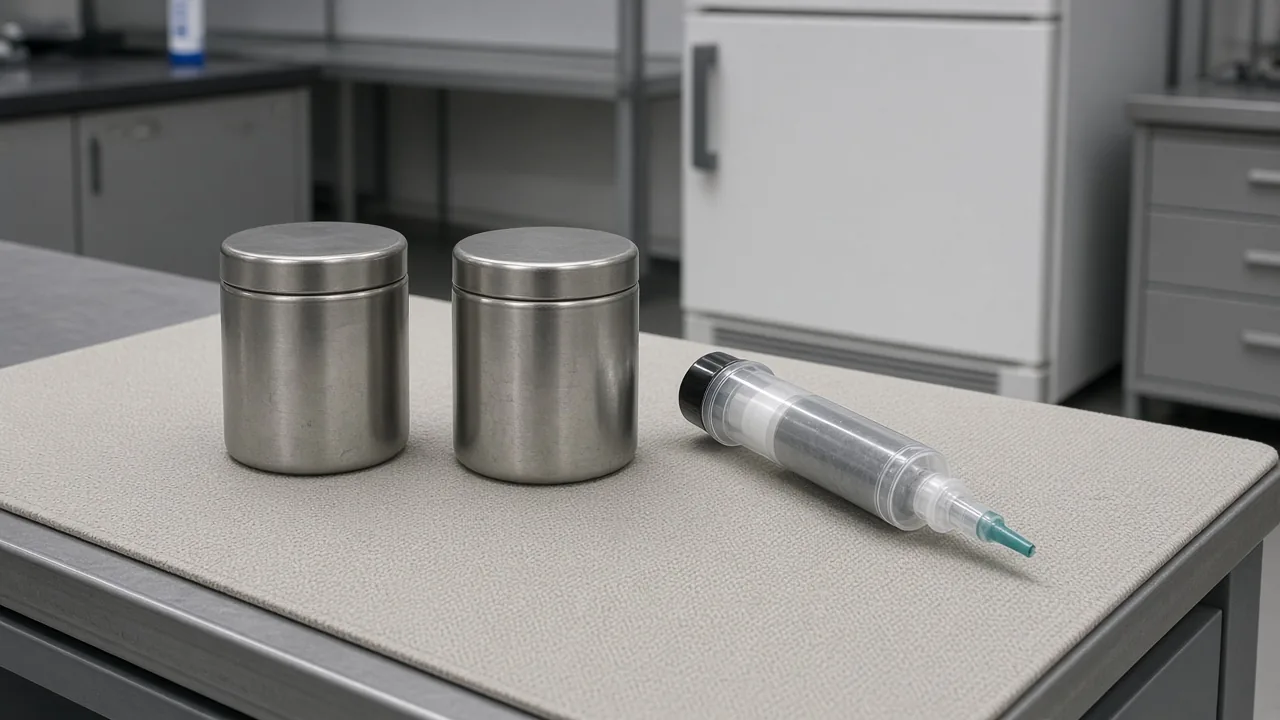
The cover photo is an illustration of sealed containers on a receiving bench. The cartridge in that photo lies with the nozzle toward the front edge. Indium’s interview tells its users to store cartridges tip down. Use the interview for Indium cartridges. Do not treat the photo as an orientation spec.
Takeaway: Three suppliers published three different storage pictures. The row stores the picture that belongs to this part number.
How long does a sealed container warm before you open it?
Warm the container sealed, for the time your datasheet gives for that fill weight, until the paste itself is at the temperature the datasheet requires. Then open it.
Indium’s interview, for the 500 gram and 600 gram containers they usually sell, says to take the paste out two or three hours before use and let it come to room temperature in room air. A water bath held at room temperature can speed heat transfer. A heater, a radiator, or the warm side of the stencil printer is rejected in that interview. Zarrow adds that conditioning time changes with the mass inside, and that his preference is a thermocouple in that container size so the plant knows the wait. Sandy-Smith agrees that a special container needs its own rule of thumb. Paste that is still cold will not print well.
Fitech’s usage note says to place the paste at room temperature for about two to four hours, then stir it fully for about three to five minutes, before use. That is Fitech’s published timing, read from the 28 August 2024 page.
Steve Stach, president of Austin American Technology, on the Circuitnet panel, gives the reason to wait before the lid comes off: let the paste reach room temperature before opening so water does not condense on it, and so the rheology is what the printer expects. He describes solder paste as a non-Newtonian fluid whose viscosity falls when it is sheared, and he stirs gently with a spatula so the first prints are not incomplete from stiff paste. He also says to avoid folding air into the paste.
Richard Stadem lists other warm-up examples on that panel: three or four hours at room temperature, one hour at room temperature with a benchtop fan, or a centrifuge mixer he prefers because it is fast and repeatable. He then wants a small-sample viscosity check on a Brookfield or Malcom viscometer, against a chart of minimum, preferred and maximum viscosity for each part number. Those are his examples and his check. They are not a second datasheet. If your sheet specifies a warm-up and a viscosity window, follow the sheet. If it is silent on a centrifuge, do not add one because a panel answer liked it.
The mixing advice on the same sources does not line up. Sandy-Smith stirs a jar gently with a plastic spatula and tells people to avoid a paint stirrer or other equipment. A jar that needs hard stirring, in her account, already has something wrong with it. A cartridge stored tip down should squeeze out. Stach also wants a gentle spatula and no air pockets. Stadem’s centrifuge is the opposing suggestion. Write the mix method from the datasheet. When the datasheet is silent, the two spatula descriptions are the narrower action, and the centrifuge stays an unadopted panel opinion.
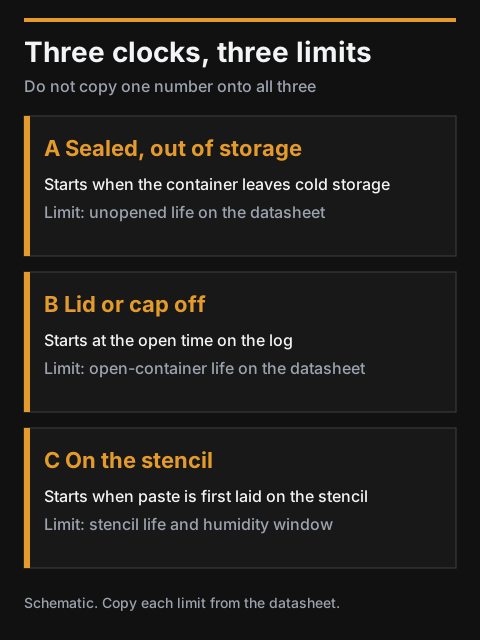
Figure 1. Sealed time, open-container time and stencil time are separate. Schematic. Copy each limit from the datasheet.
Clock A is the sealed wait after the container leaves cold storage. Clock B starts when someone opens it. Clock C starts when paste is on the stencil. KOKI’s shelf-life band is an unopened, refrigerated life. It is not a stencil life. Fitech’s two-to-four-hour warm-up is not an open-jar life. Indium’s eight-hour stencil check, below, is not a refrigerator life.
Cold paste that prints short shows up after reflow as incomplete joints. The defect table in the reflow profile guide is the place to separate a handling fault from a profile fault. Once the paste is printing, setting the profile for your board is the next measurement. Oven zone setpoints are a different specification from the room the jar warmed in. What else belongs in the oven specification covers the oven side.
Common mistake: Putting a cold jar on a heater to save the wait. Indium’s interview rejects that. The only faster method in that interview is a water bath at room temperature, used to move heat into a large jar, not to heat the paste above the room.
Takeaway: Write the warm-up time next to the fill weight. Open the container after the paste has reached the temperature on the datasheet.
What do you do with paste left in the container?
Close it, quote the room-temperature life from the datasheet, and choose a disposition. Returning the container to the refrigerator is the step these sources do not share.
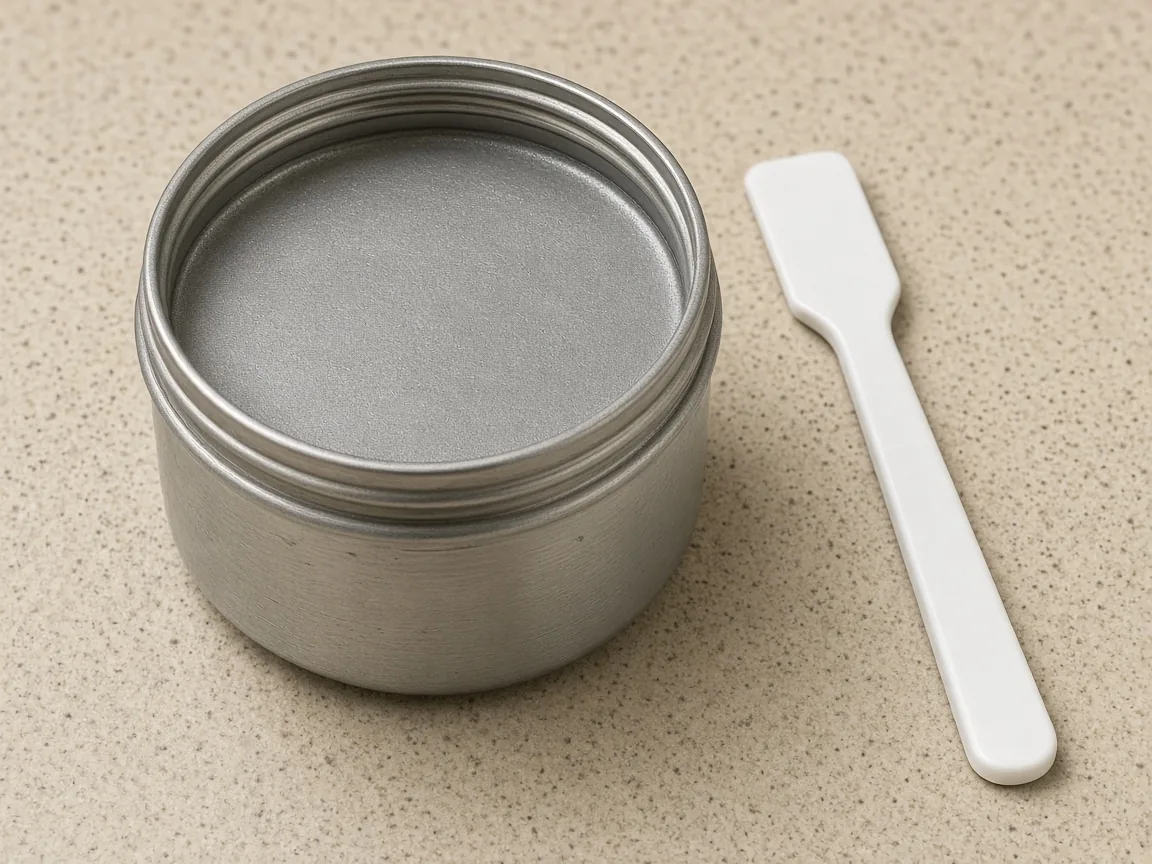
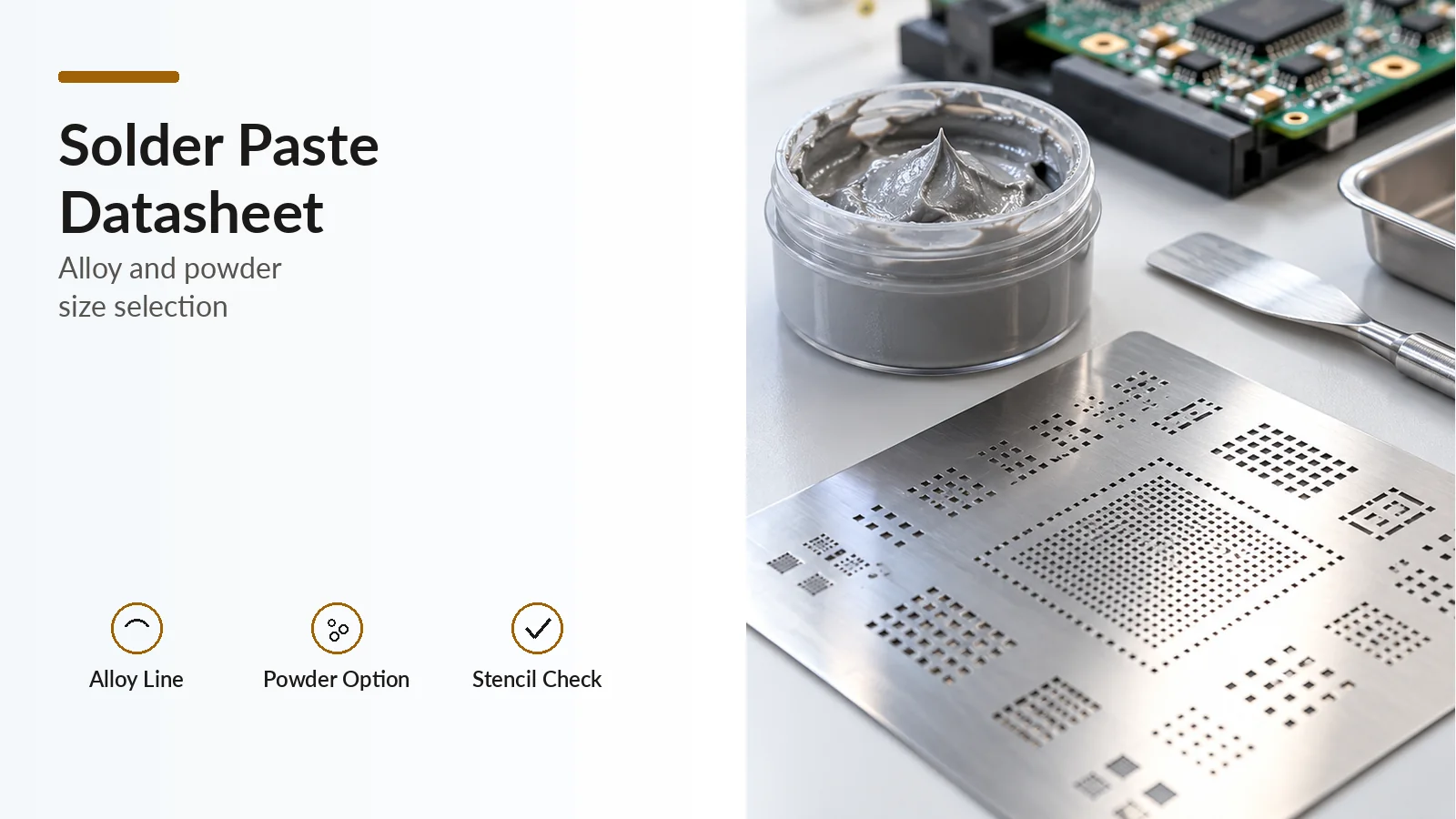
An open jar of solder paste beside a plastic spatula, matching the gentle stir described in the Indium interview. Follow the stir method on the datasheet for the paste in the jar.
Sandy-Smith’s answer on a partial container is direct. Paste goes into the refrigerator at receiving. Once you take it out to use it, she would never put it back. Zarrow then narrows the room-temperature discussion to a closed container: a lid on the jar, or a cap on the cartridge, not an open vessel. For Indium8.9HF she states a one-month shelf life at room temperature, so a jar that has been out three days or five days still sits inside that product’s closed-container window. She also says best practice is not to leave the jar out for 30 days and then use it. The month is a confidence margin for that product, not a target.
Stadem draws a jar-versus-tube line on the Circuitnet page. Jars are resealed immediately and are never re-refrigerated once opened. He suggests a five-to-eight-day limit after a jar is opened, then discard, and he labels that limit as his guideline, which depends on brand and type. He notes the removal time on a label. A sealed tube or cartridge, in the same answer, can sit out 10 to 15 days, and he calls those numbers his own suggested guidelines: some pastes last longer at room temperature, and some are no good after a couple of days. He then describes a move Sandy-Smith does not: if he needs only a little paste from a nearly full tube, he takes the tube from the refrigerator, dispenses, recaps, and returns the tube within two minutes. He says he would not do that with a jar. His reason is condensation inside the tube. That is one engineer’s practice. It is not Indium’s published handling interview, which says paste taken out for use does not go back.
Brien Bush, manufacturing applications specialist at Cirtronics, answers the same Circuitnet question by sending the reader to the paste manufacturer’s instructions for storage, use and stencil life for the precise paste in use. When Sandy-Smith and Stadem disagree, Bush’s line is the one this checklist follows: the datasheet wins, and a silent datasheet means you ask the supplier before anyone returns a container to the cold.
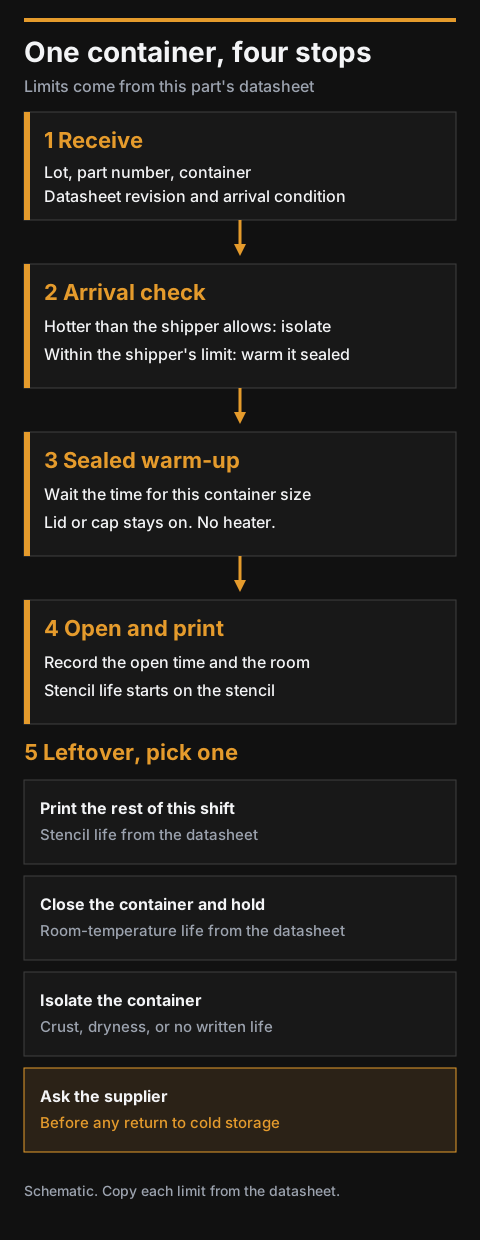
Figure 2. Receiving, arrival check, sealed warm-up, printing, then one leftover disposition. Schematic. Copy each limit from the datasheet.
The four leftover outcomes:
- Print the rest on this shift. Keep adding smaller amounts to the bead already on the stencil if your procedure says so. Stadem’s guideline is to add paste about every 7 to 10 prints and to roll it into a bead rather than a sliding pile. Treat that frequency as his guideline. The stencil-life cell still comes from the datasheet.
- Close and hold. Lid or cap on. Quote the room-temperature life, the units, and the revision. The hold ends when that life ends, or sooner if the surface crusts or dries.
- Isolate. Use this when the arrival was hot, the paste is crusted or dry, separation is extreme, the written life has run out, or the datasheet revision was never recorded. KOKI ties use past the expiration date to higher viscosity, hardening and printing trouble. Do not extend an expired lot because a different product lasted longer on a stencil.
- Ask the supplier before any return to cold storage. Use this when the datasheet does not describe a return step. Do not average Indium’s “never return it” with Stadem’s “two minutes for a tube.”
Takeaway: Quote the leftover rule from this datasheet, sign the disposition, and ask the supplier when the sheet is silent on a return to the refrigerator.
Which signs mean you isolate the lot?
Isolate on what you can see, and on a clock that has run out. Do not wait for a bad board to make the decision.
Sandy-Smith says a little flux separation in a jar is normal. Extreme separation, crust on the edges, or a dry surface is a red flag, including after a hot trip. A gentle stir with a plastic spatula should restore a normal jar. If the paste needs a hard stir, she treats the paste as already wrong. A cartridge that will not squeeze out, after tip-down storage, belongs in the same conversation with the supplier. Stadem’s comparison is a jar of peanut butter: a deep layer of separated oil, or a dry, cracked surface, is material he would throw out. Use those two visible signs.
Stencil life is the third clock, and the published examples span a range on purpose.
- Indium’s interview: Sandy-Smith has tested Indium8.9HF through a production day and states that she verifies the paste for a full eight-hour shift, including a procedure that makes one bead last the day. She has also left that paste on a stencil over a weekend and still seen transfer, and she says that weekend exposure is not best practice. The point she draws is confidence for a second shift on the same bead, not a recommendation to leave paste out all weekend.
- Pitarys, technical expert at KYZEN, on the Circuitnet page: follow the paste maker. His worked example is a common no-clean, halogen-free, lead-free Indium paste with stencil life greater than 8 hours at 30 to 60 percent relative humidity and 22 to 28°C. He also says an under-stencil wipe often falls between every 10 and 20 prints, averaging about 12 to 15, and that a full stencil clean is often scheduled from the paste’s stated stencil life. Product, shop temperature and print rate change that interval.
- Stadem, same page: define stencil life per part number. Some pastes are good for 3 to 4 hours. Others print well up to 8 hours.
An eight-hour figure from Indium8.9HF does not license an eight-hour bead of a paste whose sheet says 3 hours. A shop at 18°C or at 70 percent relative humidity is outside the window Pitarys attached to his example, so that example’s hours do not transfer. Write the hours and the window from your sheet. If you do not measure the room, write “not measured” in the room cell and do not claim the window was met.
Stach’s cleaning comment is a two-hour rule of thumb, and he says the right frequency varies with formula, ambient temperature and how often you print. Pitarys says a two-hour full clean can be more often than a line needs if the prints are still good. Both comments are about the printer, not about extending paste life. Keep them out of the leftover-rule cell.
Takeaway: Isolate crust, dryness, extreme separation, a hot arrival, and any lot whose written life has run out.
When this checklist does not apply
The log is for solder paste that you receive, warm, print and then hold or scrap. Alloy choice, wave solder and hand-soldering wire are in the guides linked below.
- Choosing the paste. Alloy, powder type and flux class are settled in the solder paste selection guide before this log starts. The selection guide holds those tables.
- Bar solder and liquid flux. Wave, reflow, selective and hand soldering use different metals. A wave pot is not a paste jar, and this warm-up clock does not apply to bar.
- Hand soldering. Flux-cored wire has its own storage. Where hand soldering still makes sense is the process question. Wire left on a bench is not a partial paste jar.
- A datasheet that allows room-temperature storage. KOKI says those pastes exist. Follow that sheet, record the exception, and do not refrigerate the lot because a different product is refrigerated.
- Syringes and epoxy solder paste. Fitech published colder storage for syringes and for epoxy solder paste than for its standard unopened paste. Use the matching product sheet. Keep the same log fields, and copy the numbers from that sheet.
- Expired paste. KOKI’s warning on viscosity and hardening is the reason the disposition “use” is unavailable once the quoted life has passed. A written concession, if you need one, comes from the supplier.
Takeaway: Keep the row, and refuse any life, temperature, or return-to-cold step that came from a different product.
Sources
Storage figures come from KOKI’s storage section, Fitech’s note labeled 28 August 2024, the Indium handling interview, and the Circuitnet panel. Sandy-Smith, Stadem, Stach, Bush and Pitarys disagree on mixing and on returning paste to the refrigerator. Each figure stays with the person or the company that published it.
Indium8.9HF figures (one month closed at room temperature, an eight-hour stencil check, weekend exposure called out as not best practice) are that product’s interview claims. They apply to that product. Fitech’s temperatures come from Fitech’s 2024 note. Copy any other storage figure from that paste’s datasheet.
Related reading
- How to choose solder paste: alloy, powder type and flux class, before this log.
- ROL0 and water-soluble flux: the four-character designator and the wash line, before this log treats a residue as something to leave.
- Reflow soldering profile: separate a cold-paste print fault from a profile fault.
- Reflow oven types: oven specification, which is not the jar’s warm-up.
- Wave, reflow, selective and hand soldering: when the joint is not made with printed paste.
- Electronics manufacturing articles: the rest of the SMT explainers.