Buying the wrong class of reflow oven wastes money twice: once on the machine, and again on rework when it cannot hold every joint on your board inside the profile. Start with a forced-convection oven, as a benchtop batch unit for prototypes or a multi-zone conveyor for production; infrared and vapor-phase ovens solve narrower problems.
The short answer: a reflow oven is a controlled heat source for the preheat, soak, reflow and cooling stages of a solder profile, and the right one is the simplest class that, on your loaded board, keeps the coldest joint inside the paste window while every package stays under its J-STD-020 classification temperature. Forced convection heats by moving hot gas; infrared heats by line-of-sight radiation, so shaded parts heat differently (US patent 4,792,302, 1988); vapor-phase heating cannot exceed the boiling point of the heat-transfer fluid chosen for the process (Illés et al., review). Choose by board envelope, thermal mass spread, profile needs and volume, not by brand.
This guide compares the heating methods and oven formats at category level, gives a five-step way to pick a category, and lists what to specify beyond the heater. It is compiled from IPC’s profiling guideline contents, a peer-reviewed vapor-phase review and patent literature. It does not name or rank models.
| Input or item | Typical value or source | Why it matters |
|---|---|---|
| Largest board or panel | Your fabrication drawing, mm | Sets chamber size or conveyor width |
| Tallest parts, top and bottom | Bill of materials and assembly drawing | Sets clearance height and edge-rail support |
| Component Tc values | J-STD-020D.1 Table 2B: 245–260 °C lead-free, by package (measured on the package top) | Each package must stay under its own value |
| Paste profile window | Solder paste datasheet | Defines soak, time above liquidus and peak |
| Thermal mass spread | Heaviest versus lightest part on the board | Drives soak needs and zone count |
| Atmosphere | Paste datasheet and board finish | Air or nitrogen cover gas |
| Boards per shift | Production plan | Batch versus conveyor |
| Profiling tools | Thermocouples or a profiler | Needed to prove any oven works on your board |
Which heating methods do reflow ovens use?
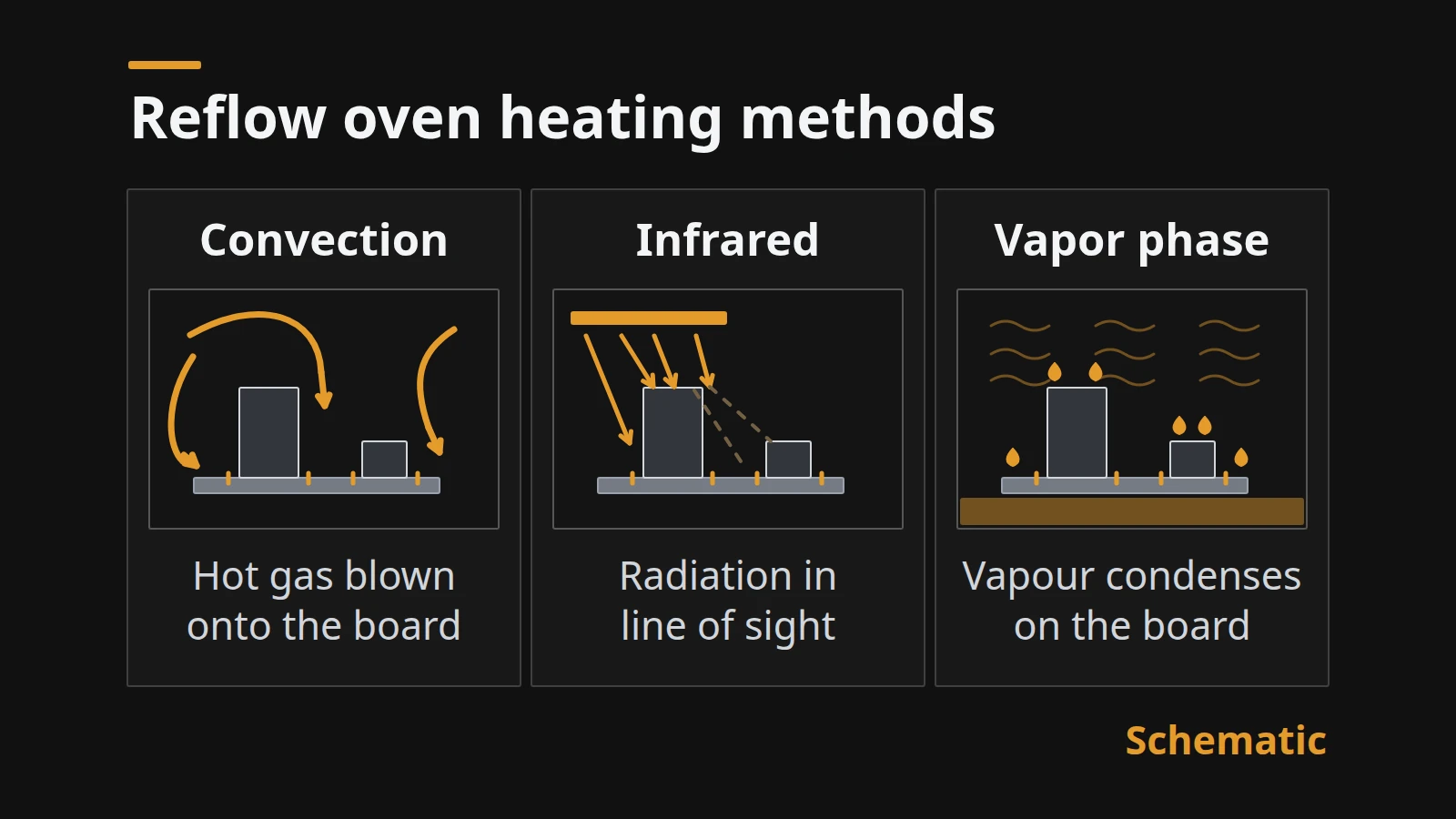
Reflow ovens rely on three main heat-transfer methods, and some ovens combine them (the 1996 patent below describes a convection/infrared design): forced convection (hot gas blown onto the board), infrared radiation (emitters radiating onto surfaces they can see) or vapor-phase condensation (vapour condensing on the cooler board). In our reading of the sources below, convection is the general-purpose starting point, infrared trades evenness for simplicity, and vapor phase serves boards that are hard to heat evenly.
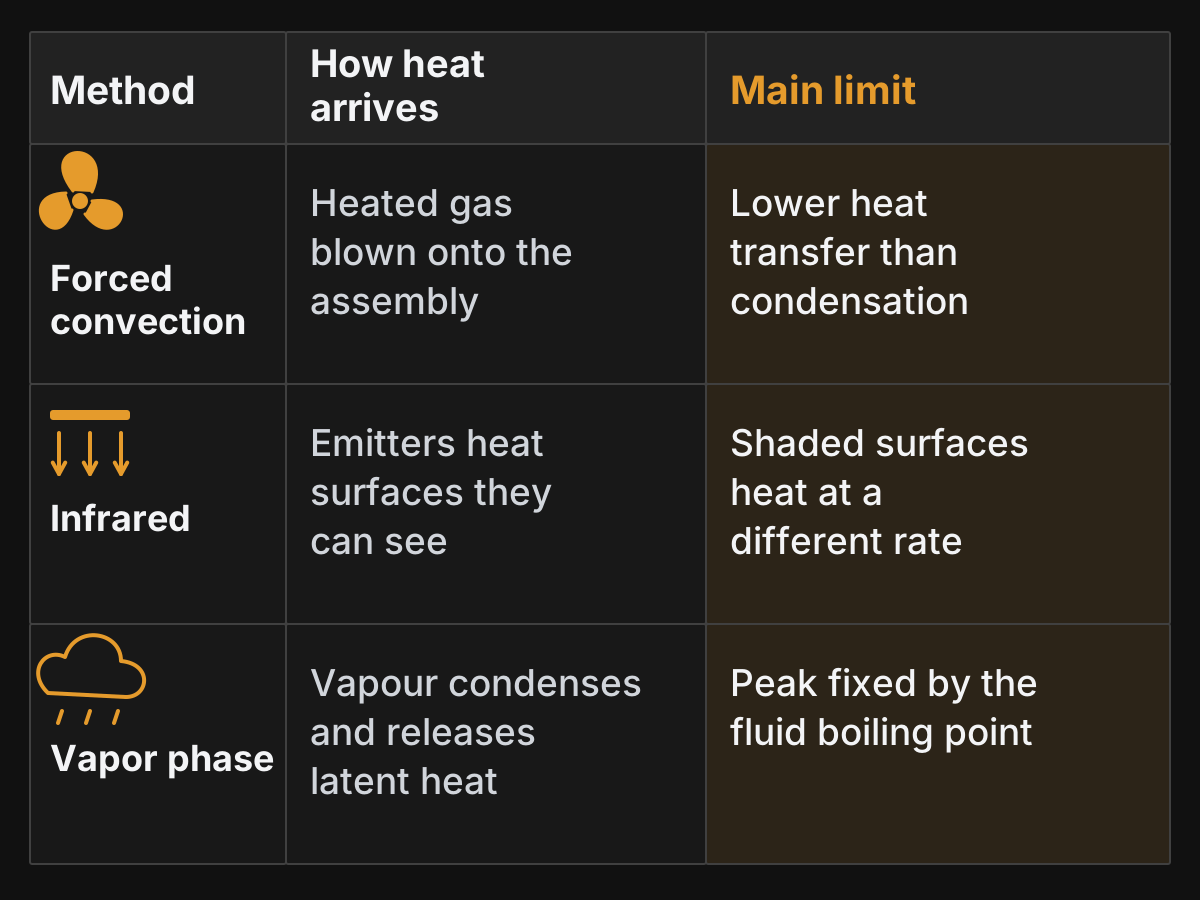
Figure 1. How heat reaches the board in each method, with the main limit of each. Schematic.
| Method | How heat reaches the joint | Where it helps | Main limit | Source |
|---|---|---|---|---|
| Forced convection | Heated gas (air or nitrogen) blown onto the assembly | General SMT; even heating across mixed parts when gas flow is controlled | Heat transfer is lower than condensation, so very heavy assemblies take longer | US 5,573,688 (1996); IPC-7530B contents |
| Infrared | Radiant emitters heat the surfaces in their line of sight | Simple, compact heaters | Shaded surfaces heat at a different rate; surfaces absorb differently | US 4,792,302 (1988) |
| Vapor phase | Fluid vapour condenses on the cooler board and releases latent heat | High thermal mass, odd shapes, no shadowing | Peak is fixed by the fluid’s boiling point; fast heating stresses moisture-sensitive parts; trapped flux gas can cause voids | Illés et al. review |
The convection–infrared distinction is old but still useful. A 1988 patent for a continuous reflow system describes infrared as line-of-sight heating in which any shadowed surface or component heats at a different rate from one directly exposed. A 1996 patent for a combined convection/infrared oven states that forced convection helps reduce hot spots and the shadowing effect occasionally noted with infrared panels. IPC-7530B, the current profiling guideline from IPC (January 2025), still carries a section titled “IR vs. Convection”, and the J-STD-020 classification curve itself is titled an “IR / Convection” profile.
Vapor phase works differently. In the review by Illés, Géczy and Harsányi (Budapest University of Technology and Economics), the board is immersed in vapour of a boiling heat-transfer fluid; the vapour condenses on the board and heats it to the fluid’s boiling point. The authors list uniform heating, an inert atmosphere and no shadowing among the advantages, and fast heating (condensation has a higher heat transfer coefficient than forced convection), voiding from trapped flux gases and more frequent tombstoning among the drawbacks. The review also discusses preheating and vacuum stages as ways to reduce some of these problems.
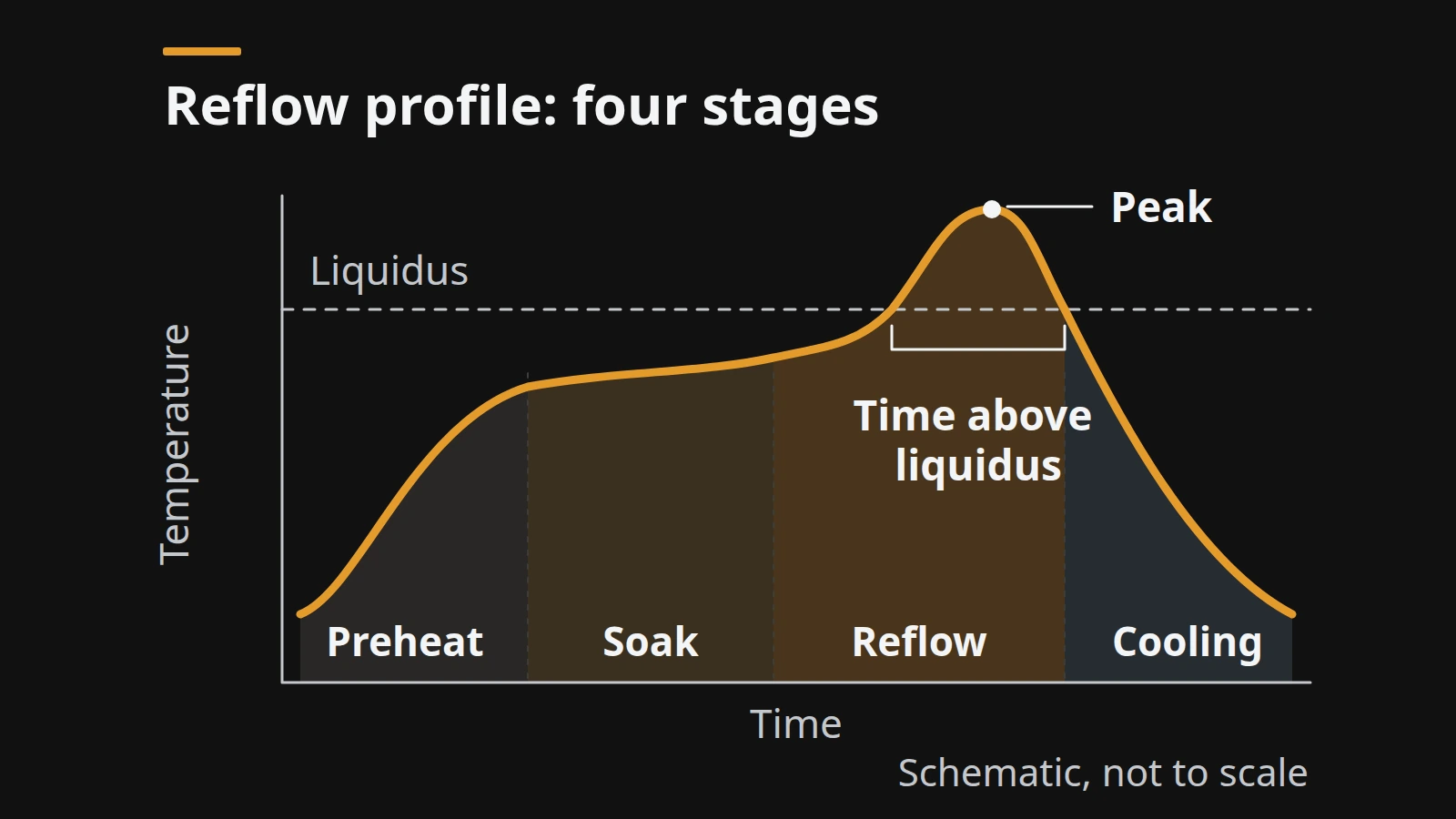
To see how each stage of a profile maps to oven zones, read our explainer on the four stages of a reflow profile.
Takeaway: Our suggestion is to start from convection and evaluate vapor phase when measured profiles on convection struggle to heat your board evenly.
Batch, benchtop or conveyor: which format fits your volume?
For prototypes and engineering builds, a batch or benchtop oven is usually enough; for repeated production of the same boards, a conveyor oven is the usual fit. The difference is how the profile is produced: a batch oven holds the load still and changes temperature over time, while a conveyor oven holds each zone at a set temperature and moves the board through them. Both can produce a valid profile; they differ in throughput, repeatability between boards and how finely you can shape the curve. Heating method is a separate choice: either format can use convection, and vapor-phase systems also come in batch and inline forms.
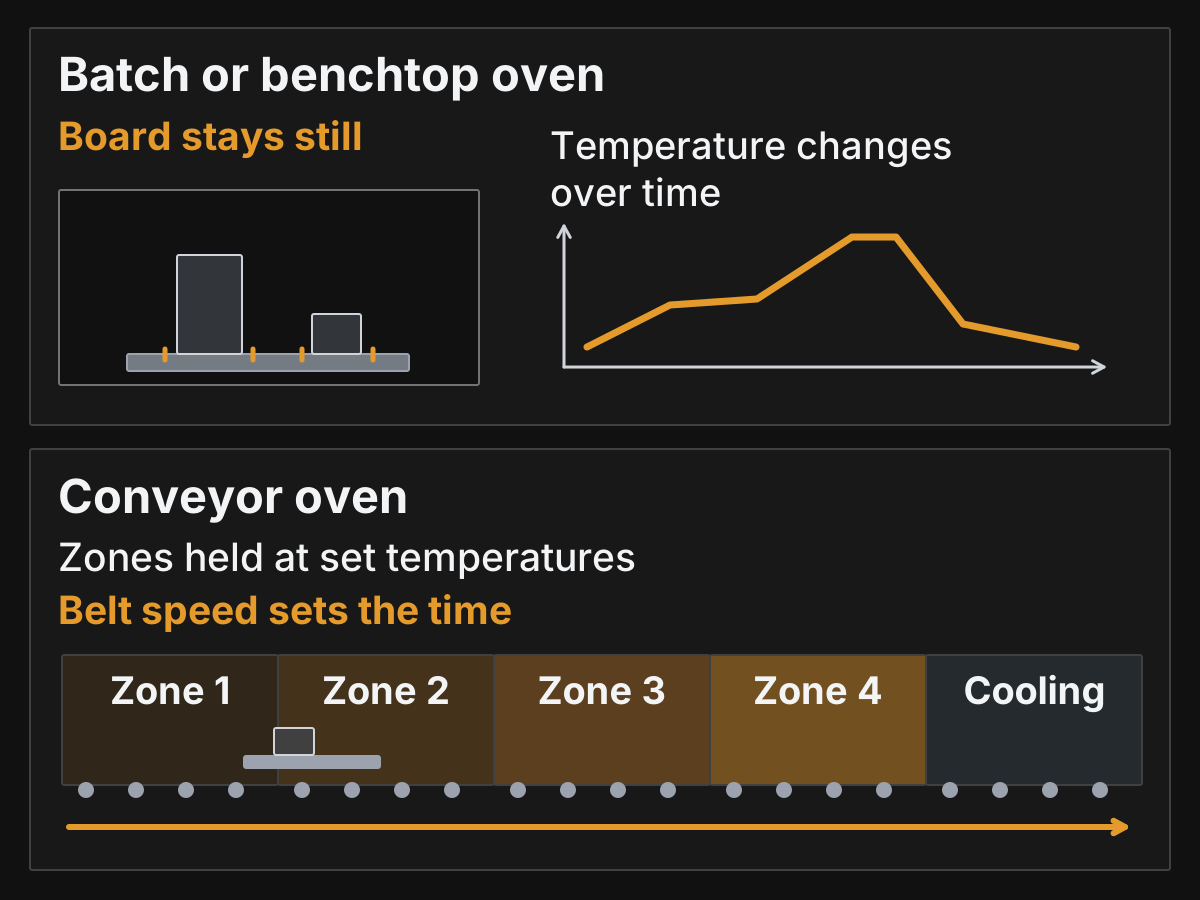
Figure 2. Batch versus conveyor: time-programmed heating in one chamber versus fixed zones and belt speed.
| Format | How the profile is made | Fits | Watch for |
|---|---|---|---|
| Benchtop or drawer batch oven | One chamber follows a time-temperature program | Prototypes, engineering builds, short runs | Board temperature lags the controller reading; check usable chamber area and loading |
| Converted toaster oven or hot plate | Appliance heater under an add-on controller | Hobby and one-off prototypes | Check evenness, sensor position and cooling before trusting it |
| Conveyor convection oven | Several zones held at set points; belt speed sets time | Production and repeated runs | Zone count and length limit how finely the curve can be shaped |
| Vapor-phase system (batch or inline) | Vapour level or heating power shapes the curve | Heavy or difficult assemblies | Fluid handling and the fixed peak |
IPC-7530B lists heating zone selection, clearance height, conveyor belt type and width, and edge-rail support as oven settings, which is a reminder that a conveyor oven’s fit depends on your board as much as on its heaters. For a board with parts on the underside, check the clearance below the board and where it will be supported (mesh belt or edge rails), and check that a wide panel fits the conveyor.
For prototype work, the constraint is usually control, not capacity. The practical limits of small ovens are covered in our notes on small-batch and hobby reflow.
Common mistake: Choosing by the number of zones on the brochure. Zone count matters when your measured profile needs a long soak or a shaped ramp; check that against your heaviest board instead of assuming more is better.
Takeaway: Pick the format from volume and repeatability, then confirm the zone count with a measured profile of your heaviest board.
Choosing an oven category in five steps
Narrow the choice with five checks: the board envelope, the thermal mass spread, the profile the oven must hold, volume and changeover, and how you will verify it. Each uses an input from the Quick Specs table above, and together they make a written requirement you can hand to any supplier and verify on delivery.
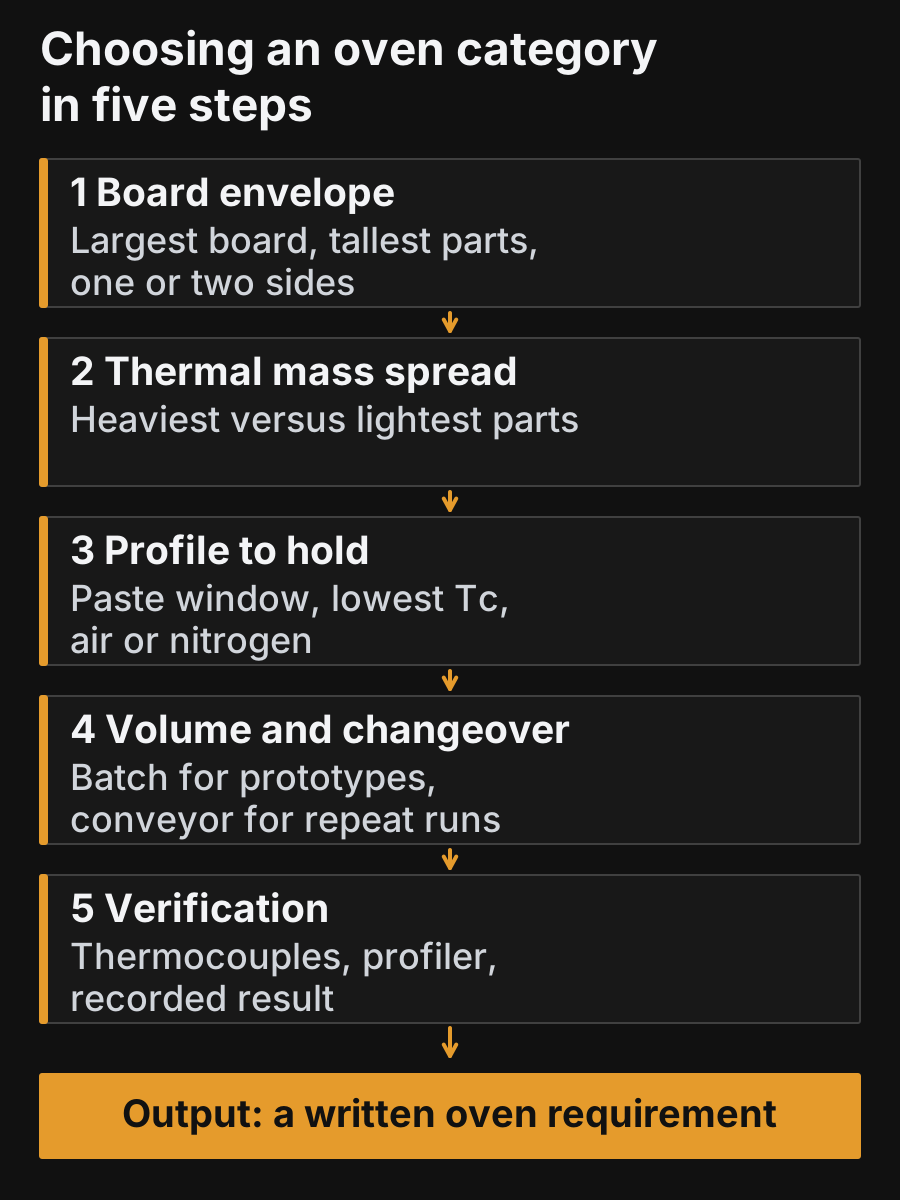
Figure 3. Five checks that narrow the oven category. Each step produces one line of the written requirement.
Step 1: Record the board envelope
Measure the largest board or panel and the tallest parts on each side. This rules out chambers and conveyors that cannot take the board and tells you what clearance and support to ask about. Boards with parts on both sides also rule out a plain hot plate.
Step 2: Measure the thermal mass spread
List the heaviest parts (large BGAs, connectors, shielding cans, parts on copper pours) and the lightest (0402 and smaller passives). The wider this spread, the more the oven must let heavy parts catch up without overheating light ones. Treat the list as a starting point and confirm the actual spread with thermocouples on a trial board; that measurement tells you whether you need a longer soak or more zone control.
Step 3: Write down the profile the oven must hold
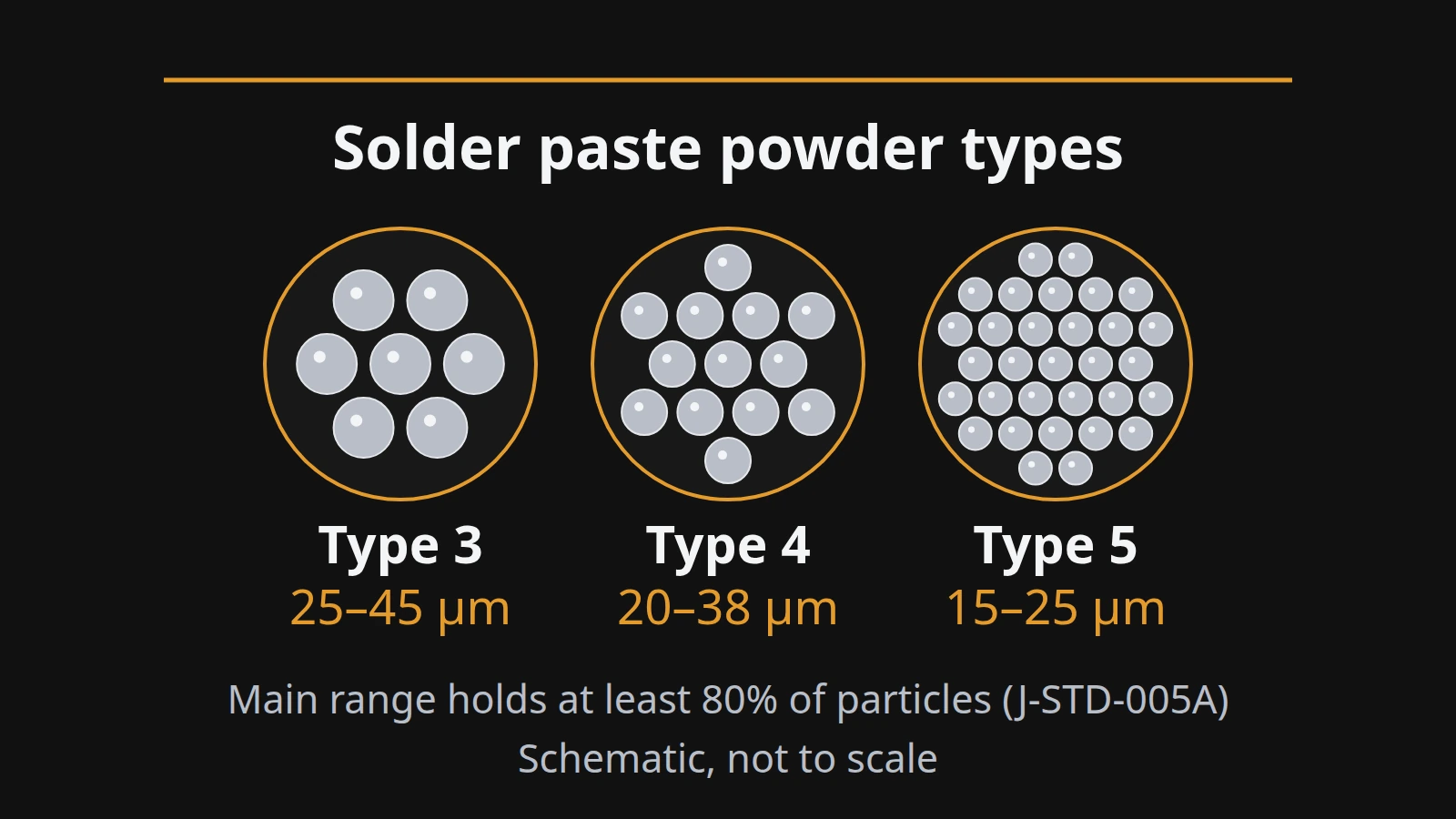
Take the soak, time above liquidus and peak from the paste datasheet and the lowest classification temperature from the parts list. Our guide to the J-STD-020 limits that cap a profile explains the numbers. Note whether the paste calls for nitrogen; if it does, nitrogen capability is a requirement, not an option. If you have not chosen a paste yet, the solder paste selection guide covers alloys and powder types.
Step 4: Match the format to volume and changeover
One-off prototypes and engineering builds fit a batch oven. Repeated runs of the same board usually fit a conveyor oven, where the recipe (zone set points and belt speed) is repeatable. Write down boards per shift, how many boards load at once and the changeover time between products, and ask suppliers to confirm them against your board. If you build many different boards in small lots, budget time for a measured profile per board, which IPC-7530B treats as standard practice under its “Unique Profile for Each Printed Board Assembly” heading.
Step 5: Plan the verification
Decide how you will prove the oven meets Step 3: thermocouples attached to the coldest and hottest parts, a profiler that travels with the board, and a record of the result. IPC-7530B devotes a chapter to profiling tools, including product profilers, machine profilers and continuous real-time convection oven profilers. Use the five-step profile setup on delivery.
Takeaway: The five answers together are your oven specification; any category that cannot meet Step 3 on your heaviest board is out.
What else belongs in the oven specification?
Beyond the heating method, five items decide whether an oven runs your boards well: atmosphere, cooling, zone layout, board handling and profiling support. Each one maps to a line in IPC-7530B’s equipment settings or profiling sections.
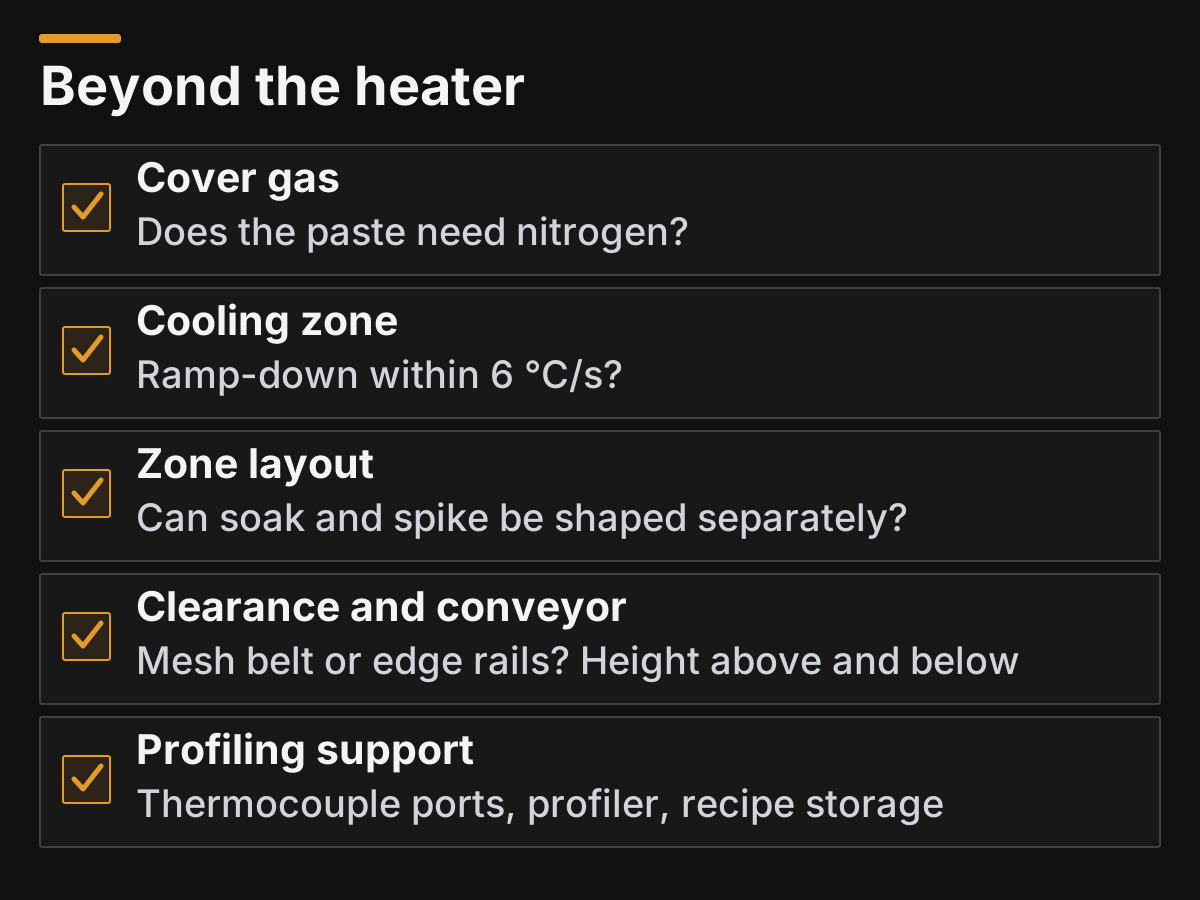
Figure 4. Specification items beyond the heater, with the question each one answers.
| Item | Question to answer | Why |
|---|---|---|
| Cover gas | Does the paste or finish need nitrogen? | IPC-7530B lists cover gas as an oven setting; the paste datasheet states the requirement |
| Cooling zone | Can it cool fast enough without exceeding 6 °C/s? | J-STD-020 caps ramp-down at 6 °C/s for classification |
| Heating zone layout | Can it shape soak and spike separately for your heaviest board? | Zone count and length bound the curve |
| Clearance and conveyor | Mesh belt or edge rails; height above and below the board | Tall or double-sided assemblies need edge-rail support |
| Profiling support | Thermocouple ports, profiler compatibility, recipe storage | You cannot verify a profile without measurement |
The cooling zone is easy to overlook. A profile can hold every part under its peak limit and still exceed the ramp-down limit if the oven’s cooling is aggressive, so check the measured ramp-down as well as the peak.
Takeaway: Specify the oven as a measured profile plus handling and gas requirements, not as a heater type alone.
Where does a wave soldering machine fit?
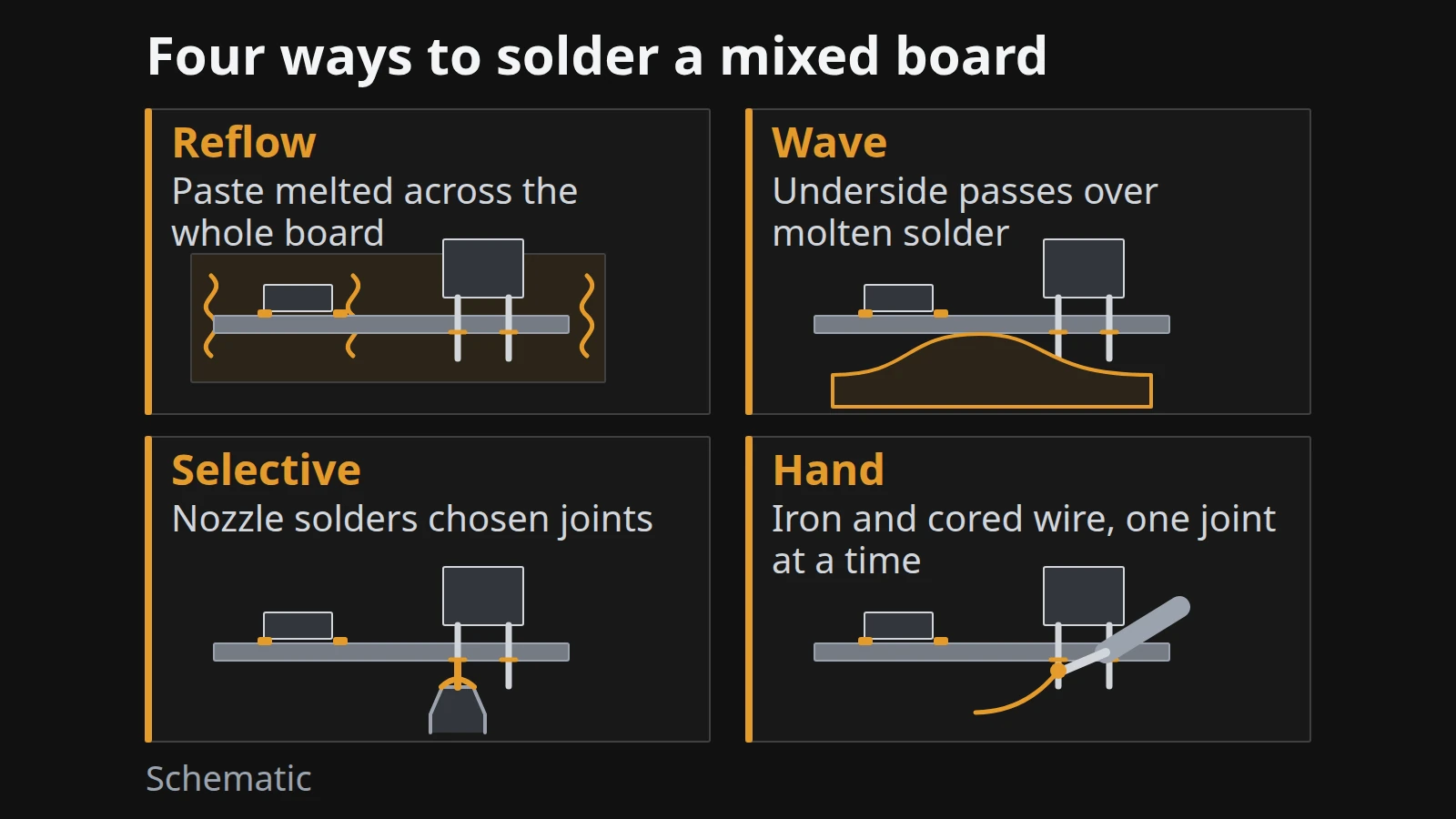
A wave soldering machine is not a reflow oven. It solders through-hole leads by passing the underside of the board over a wave of molten solder, so it is a separate decision for the through-hole parts on a board, made on component heat tolerance, board design and production conditions. Many mixed-technology lines run both: reflow for the surface-mount side, then wave or selective soldering for the through-hole parts.
Diepstraten, of selective and wave soldering equipment maker Vitronics Soltec, notes in a 2023 paper that most assemblies still carry a few through-hole components, some because they cannot withstand reflow temperatures and others for mechanical robustness, and that pallet-based wave soldering and pin-in-paste reflow each have limits. Which process to use for those parts is a separate decision, covered in our comparison of wave, reflow, selective and hand soldering and its section on when selective soldering is the better fit.
Takeaway: Choose through-hole soldering equipment as a separate decision; it complements the reflow oven rather than replacing it.
Can a converted toaster oven or hot plate do the job?
A converted toaster oven or a hot plate can reflow simple single-sided prototype boards, provided you measure the board temperature and stay inside the same paste window and component limits that apply to any oven. They are not substitutes for a production oven: check how evenly they heat across the board and whether you can control the cooling rate before relying on them.
The main gap is measurement. The controller in a converted oven reads its own sensor, so do not treat the displayed value as the joint temperature until you have compared it with thermocouples on the board. Measure at a likely cold joint and a likely hot package, with the board loaded as it will be, through the cooling stage as well. A hot plate heats from below, so parts on the underside would sit on the heater.
Treat a converted appliance as dedicated equipment once it has reflowed solder paste, which contains flux chemicals and, in tin-lead pastes, lead. For the defects that tend to appear first on uneven heating, such as tombstoning, see the defect table in our profile explainer.
Common mistake: Trusting the controller display. The displayed value can sit well away from what a large connector and a small resistor on the same board actually reach; only thermocouples on the board show the difference.
Takeaway: Hobby equipment is acceptable for prototypes when thermocouples at cold and hot points on the loaded board confirm the profile.
When this does not apply
This guide covers ovens for surface-mount reflow of tin-lead and tin-silver-copper pastes at prototype to production scale. Use other guidance in these cases:
- Through-hole-only boards. Wave or selective soldering is the main process; see our process comparison.
- Low-temperature tin-bismuth pastes. The window shifts down; take it from the paste datasheet and the alloy comparison in our solder paste guide.
- Rework of single parts. A hot air or infrared rework station is the tool; IPC-7530B treats component rework separately.
- Laser and other point-heating processes. These are outside this category comparison.
- Contracted assembly. Your contract manufacturer owns the oven choice; your job is to supply the profile requirements in Step 3.
Takeaway: If the process is not whole-board surface-mount reflow, the category comparison above is the wrong starting point.
Method and sources
Compiled on 7 October 2026 from public documents; we did not test any oven. The comparison is at category level and names no models. IPC-7530B is cited from its published table of contents; vapor-phase mechanisms come from the Illés, Géczy and Harsányi review; infrared and convection statements come from the background sections of the two US patents listed. Classification temperatures are from J-STD-020D.1 Table 2B as reproduced by Cypress/Infineon (the revision E sheet from Bourns lists only the 260 °C peak). Quoted papers from equipment makers are labelled as such. Sources are listed at the end of the page.
Related reading
Pick the next article by the input you are missing.
- Reflow soldering explained: stages and temperature profile — Understand the profile an oven has to produce.
- How to choose solder paste — Pick the paste whose window the oven must hold.
- Wave vs reflow vs selective vs hand soldering — Decide how to solder through-hole parts on a mixed board.
- All electronics manufacturing articles — Browse the rest of the SMT explainers.