Choosing a solder paste flux by the words no-clean or water-soluble fails when the four-letter designator and the wash instruction disagree. The paste is alloy powder mixed into a flux. The designator classifies that flux. The wash line says whether the residue stays.
The solder paste selection guide already records powder size, alloy, and the J-STD-004A reading of ROL0 and ORH1. This page stays on the flux letters. After the class is chosen, the storage checklist is the lot log.
| Offer line | Dominant failure mode | Prevention |
|---|---|---|
| “No-clean” with no designator | The activity letter and the halide band are unknown | Copy the four characters from the datasheet |
| OR read as water-soluble | A no-clean OR paste is washed, or a washable paste is left on | Read the wash line, not the OR letters alone |
| Digit 0 read as low activity | ROH0 is high activity and still under 0.05 percent | Read the third character separately |
| ORH1 with the wash skipped | A water-washable residue stays active if it is left | Keep the wash when the datasheet requires it |
Read the four characters separately
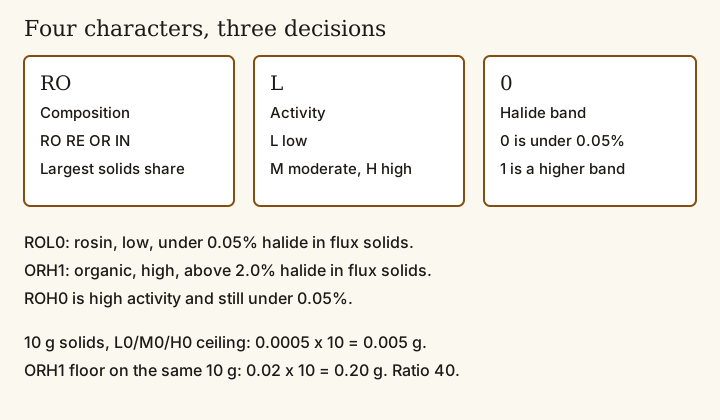
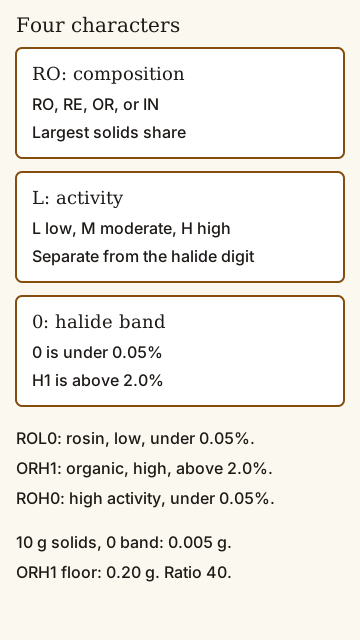
IPC’s November 2011 table of contents for J-STD-004B with Amendment 1 prints Table 1-1, the flux identification system. Composition is RO (rosin), RE (resin), OR (organic), or IN (inorganic). Activity is L (low), M (moderate), or H (high). The last character is the halide band, by weight in the flux solids.
Every digit-0 row in that table is under 0.05 percent. Footnote 1 says a halide measurement under 0.05 percent by weight in flux solids is halide-free. Digit 1 is not one number. L1 is under 0.5 percent, M1 is 0.5 to 2.0 percent, and H1 is above 2.0 percent. Footnote 2 says 0 and 1 indicate absence or presence. The cells above are the percentages that go with those digits.
Indium, quoting J-STD-004B section 3.3.1.1 on the page read 20 October 2026, says the flux is classified by the largest weight-percent constituent of its nonvolatile portion. OR means that share is organic. It does not mean the residue must be washed.
ROL0 is a class, not a cleaning slogan
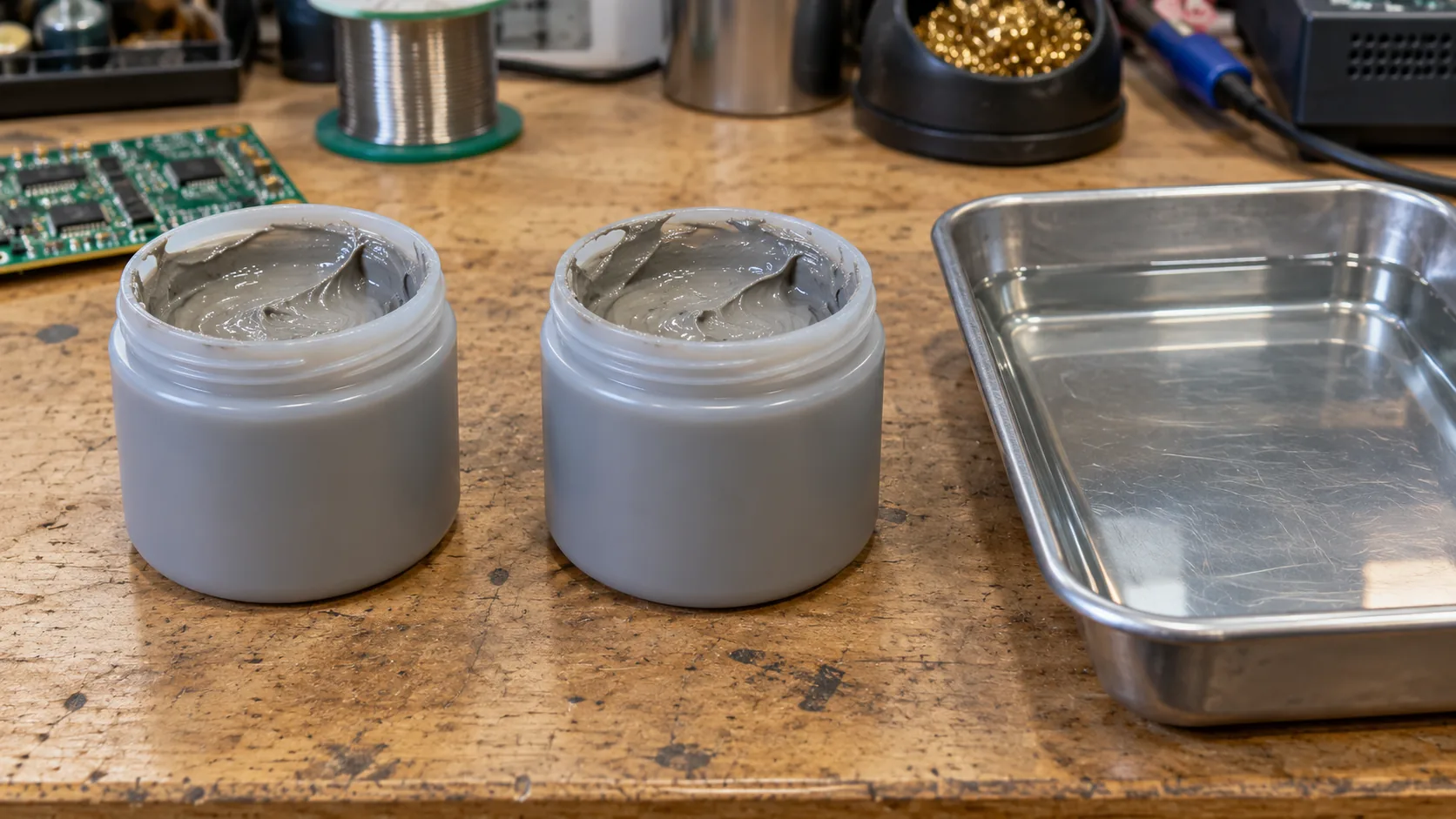
ROL0 in Table 1-1 is rosin, low activity, and the under-0.05-percent halide cell. The selection guide records Tony Lentz’s no-clean set as ROL0 and his water-soluble set as ORH1. Those are the fluxes in that study. Another datasheet can print a different designator for a paste that is also left unwashed.
ROH0 is the counterexample inside the same table. It is still rosin and still under 0.05 percent halide, and the activity letter is H, not L. A buyer who stops at “ends in 0” has not read the activity.
Water-soluble is the wash instruction
ORH1 in the same table is organic, high activity, and above 2.0 percent halide. Lentz used an ORH1 flux as his water-soluble paste. Indium’s page says buyers often treat every OR material as water-washable, and that some OR pastes are no-clean, leave little residue, and do not require cleaning. The letters name composition and activity. The datasheet names the wash.
The selection guide records Chrys Shea’s point that a water-washable flux is corrosive and has to be cleaned off, and that residue left on the board keeps acting on the metals. When the datasheet requires the wash, the wash is part of the process. When the datasheet says the residue stays, an extra wash is a step the board did not call for.
Rules of thumb
- If the last character is 0, Table 1-1 puts halide under 0.05 percent by weight of the flux solids.
- If the designator is ORH1, Table 1-1 puts halide above 2.0 percent by weight of the flux solids.
- If the letters are OR, that is composition. The wash decision is the datasheet line, not the letters.
- If the third character is H, activity is high even when the halide digit is 0. ROH0 is that row.
One solids weight, two halide bands
The percentages are shares of the flux solids, not of the whole paste. For a solids mass m:
w_0 = 0.0005 × m
w_H1 = 0.02 × m
On 10 grams of flux solids:
0.0005 × 10 = 0.005 g
0.02 × 10 = 0.20 g
0.20 / 0.005 = 40
The ORH1 floor is 40 times the digit-0 ceiling, on the same solids weight. That comparison uses the band edges in Table 1-1. It is not a halide assay of a jar. Metal percent in the paste is a different number, recorded on the selection guide from Lentz’s lab pastes.
What the designator leaves blank
Table 1-1 does not print a post-wash ion limit, a surface-insulation-resistance pass value, or a copper-mirror breakthrough rule. The contents list those tests. The pass numbers sit in the standard body and in the assembly specification named on the drawing. Copy that limit from the specification you build to. Do not fill it from the four letters.
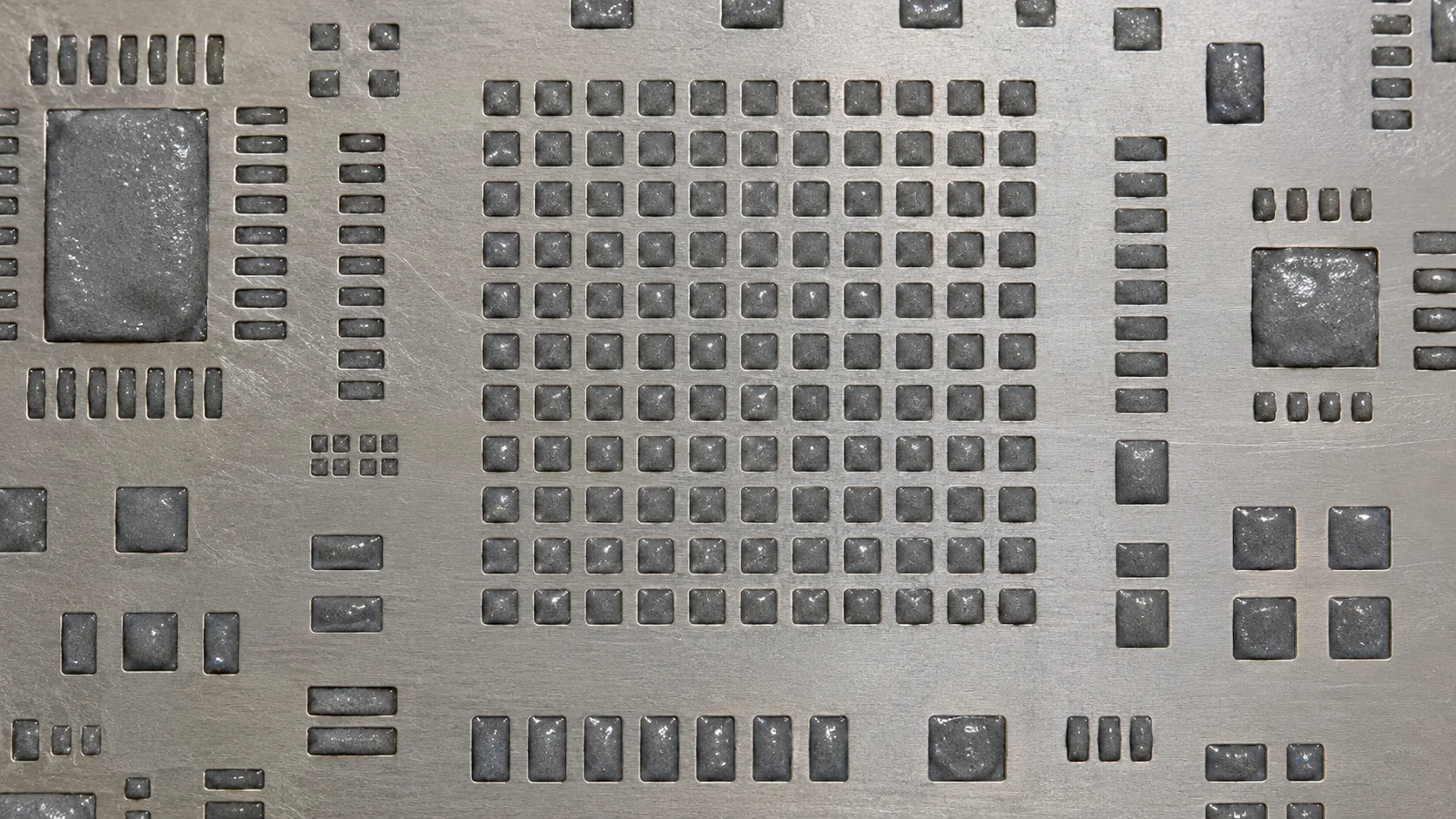
Solder paste and flux are not substitutes. The selection guide records Shea’s scope: paste, liquid flux, and cored wire are separate forms. The flux already in the paste is the designator on that jar. Flux added at rework is a second material.
Takeaway: write the four characters, the J-STD revision named on the sheet, and the wash instruction on the same row. Then log the lot on the storage checklist. A wash that the datasheet does not require is process time and water spent on a residue that was specified to stay. A wash the datasheet does require is the step that removes a residue Shea treats as still active.