Ordering a solder paste powder class that the product datasheet does not list can waste a purchasing cycle and leave a stencil trial without a documented material. Select solder paste by its exact formulation, alloy, listed powder option, and flux code; then qualify that combination on the intended stencil and through reflow. A generic powder class is only part of the order identity.
This walkthrough uses AIM’s alloy and paste documents to show what to copy, what still needs confirmation, and where a promising print result can hide a reflow problem. It applies to stencil-printed electronics assemblies. The solder paste types guide holds the powder bands and stencil calculations.
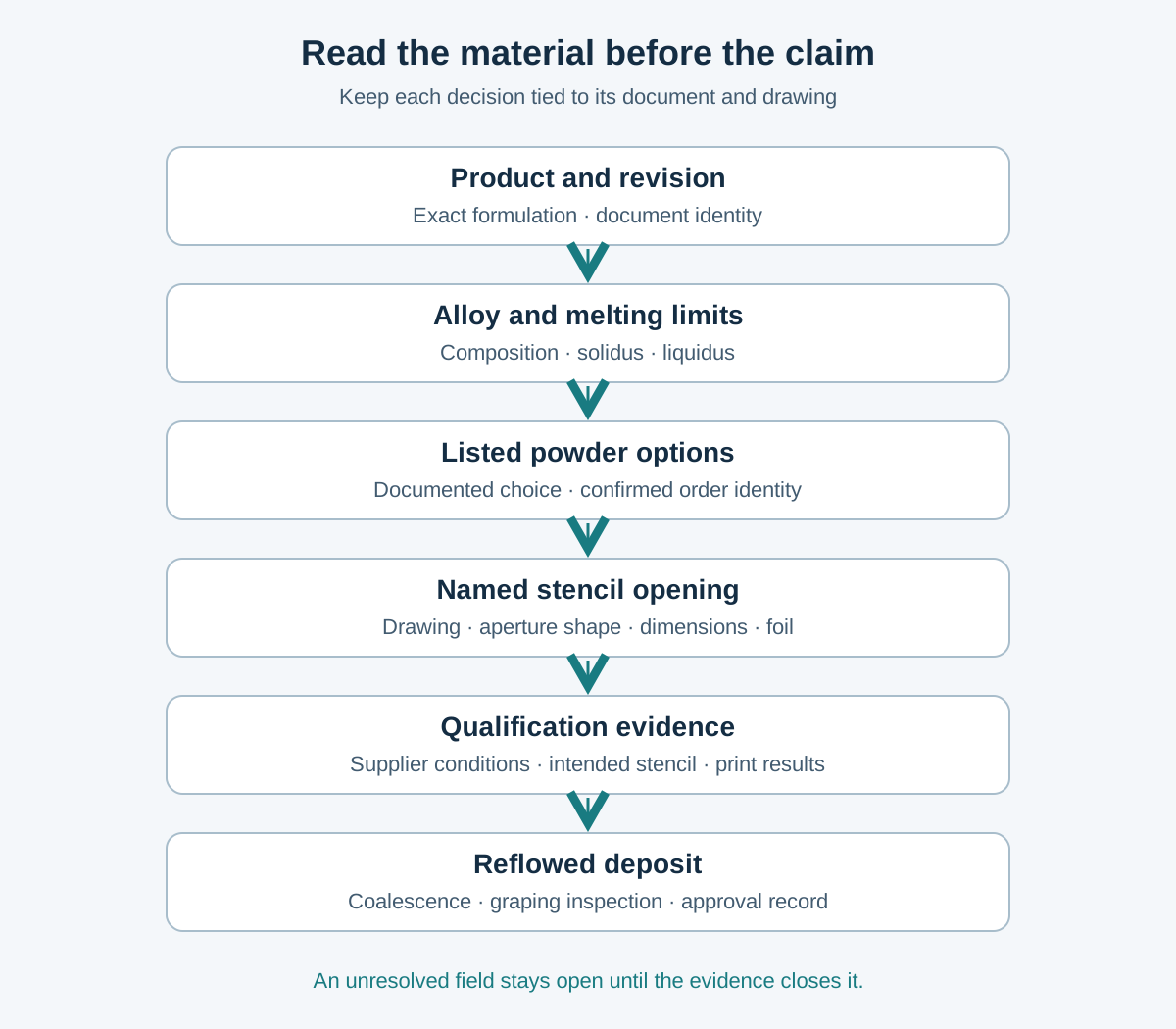
Start with the product name and document revision
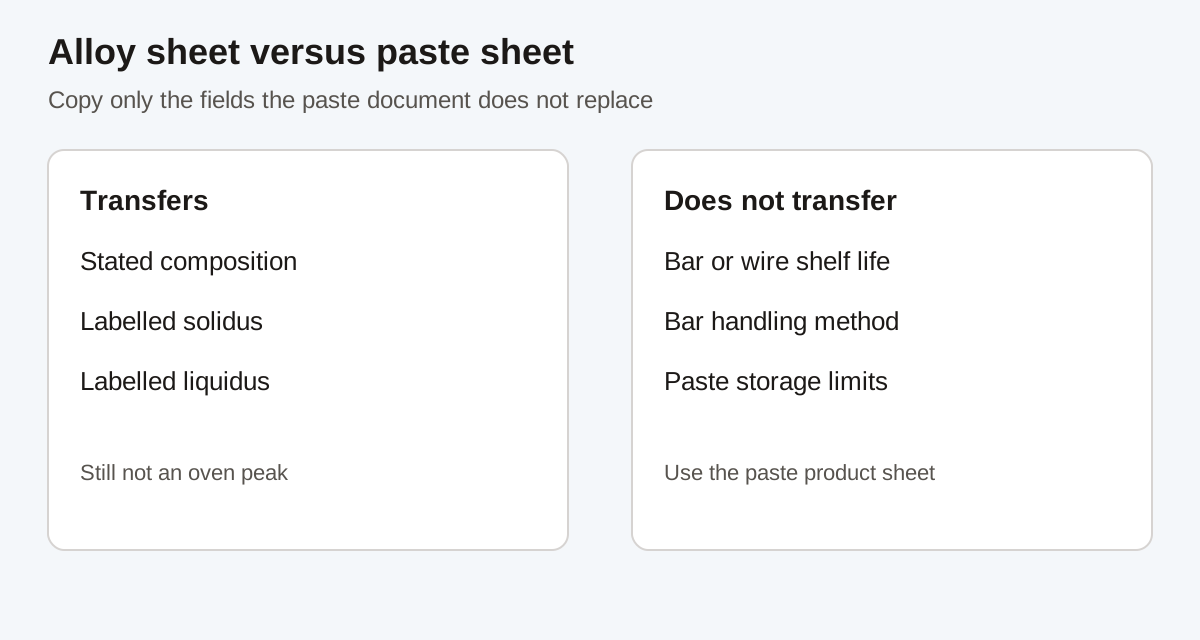
Keep the paste technical data sheet beside the alloy sheet. Record which document supplies each field so an alloy property cannot accidentally become a paste handling instruction.
For the paste example, the AIM H10 technical sheet prints revision _NF14_May_4_2026. Save that identifier with the selected alloy and powder option. A file downloaded recently may still contain an older revision; the download date cannot replace the printed revision.
Before an order is released, reconcile the proposed material description with the supplier’s order identity. A portfolio listing can establish a candidate without establishing stock availability or every possible alloy/powder combination. If the order confirmation describes a different powder option, resolve that difference before using the material for qualification.
Read the alloy and its melting endpoints
The AIM SAC305 alloy TDS, revision NF7, directly states 96.5% tin, 3% silver, and 0.5% copper, with solidus 217°C and liquidus 220°C. Copy the endpoint labels as well as the temperatures. Solidus marks the start of melting; liquidus marks the fully liquid boundary for the alloy.
Those values are material properties. They do not specify an oven peak, soak, or complete board profile. The H10 product data independently gives the same melting interval for its SAC305 row. Keep the profile decision tied to the selected paste’s profile guidance and the assembly’s limits; use the reflow profile guide for the board measurement workflow.
The alloy sheet also covers solid bar and wire handling. Those storage instructions cannot set the shelf life of a paste formulation. Once the exact paste is selected, put its own handling specification into the solder paste storage checklist.
Compare the powder options the formulation actually lists
The H10 TDS lists T4 and T5. Its product page identifies T4 as standard. Type 3 is absent from the fetched TDS’s powder options. That establishes the documented choices for this example; it does not prove that an unlisted option is impossible to supply.
Use the existing powder-band reference to interpret the classes. AIM’s Solder Powder Size Quick Guide provides a manufacturer cross-check and labels its aperture reference as based on the five-ball rule. Keep the dimensional tables at those references.
| Candidate for the H10 example | Documented position | Dominant Failure Mode & Prevention |
|---|---|---|
| Type 3 request | Absent from the fetched paste TDS’s option list | An incomplete purchasing specification: obtain explicit product documentation before treating it as an orderable candidate. |
| T4 | Coarser of the listed options; standard on the product page | A listed option still needs stencil qualification: verify release on the intended opening and foil. |
| T5 | Finer listed option | More exposed powder surface increases the flux’s oxide burden: check coalescence after reflow as well as the wet print. |
The graping mechanism behind the last row is described in Indium’s graping guidance. It is a reason to inspect a candidate, not a measured defect rate for H10.
Rules of thumb: Choose the coarsest documented option that passes the powder screen. Evaluate stencil geometry separately. When either screen leaves uncertainty, qualify the complete formulation on the intended stencil and inspect the reflowed deposits before approving the material.
Tie the candidate to a named stencil opening
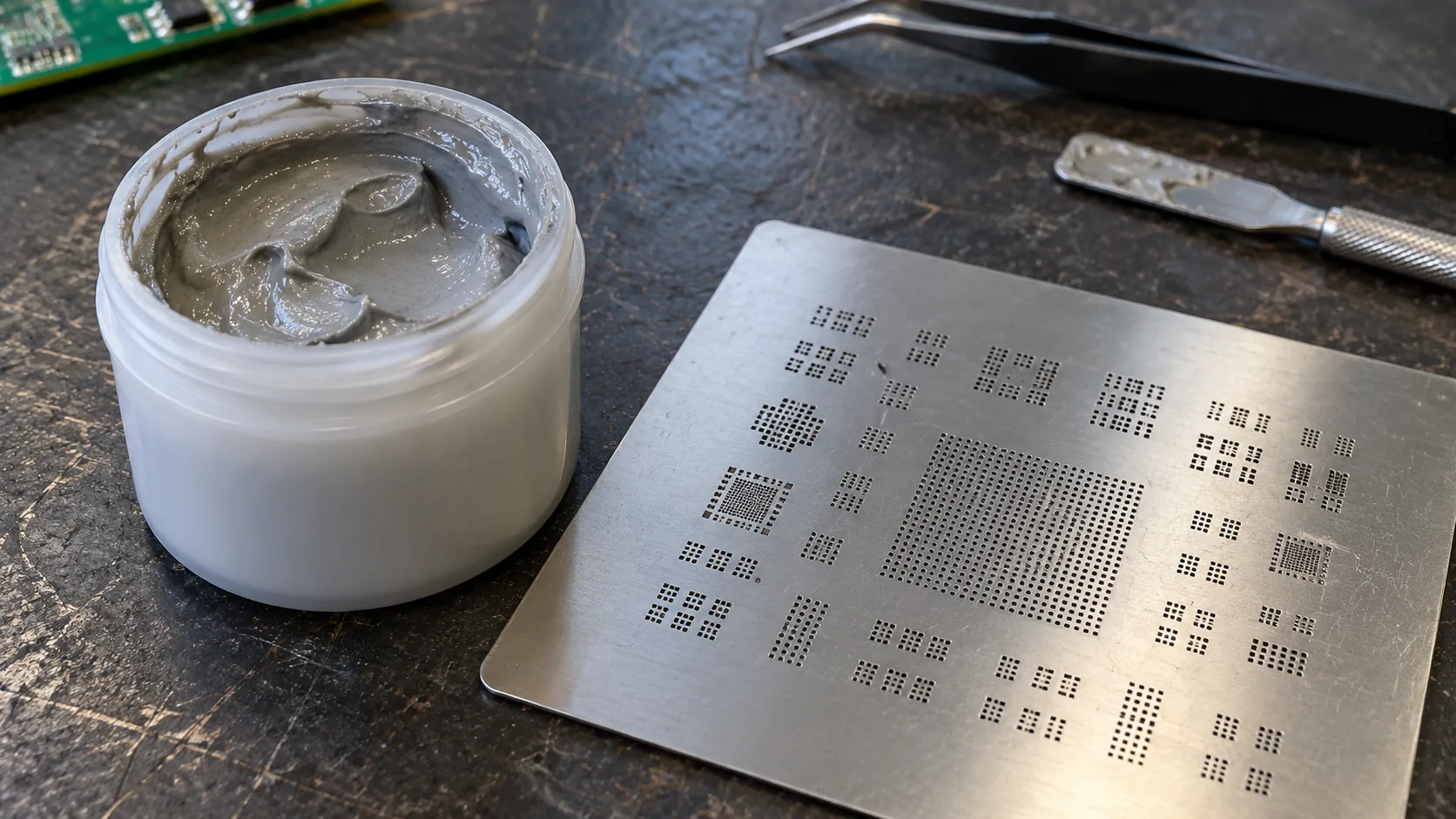
Attach the stencil drawing to the material record. Name the opening or pad location being evaluated, its shape and dimensions, and the foil thickness. This makes the selection reviewable: another engineer can identify the same opening and repeat the screen.
Apply the powder and area-ratio checks in the existing guide. Its named Lentz BGA test pattern illustrates the distinction: the powder screen does not force the finer H10 option, while stencil release still needs attention. Within H10’s documented options, T4 is therefore a candidate to investigate. Neither that comparison nor the source example qualifies H10 on Lentz’s aperture.
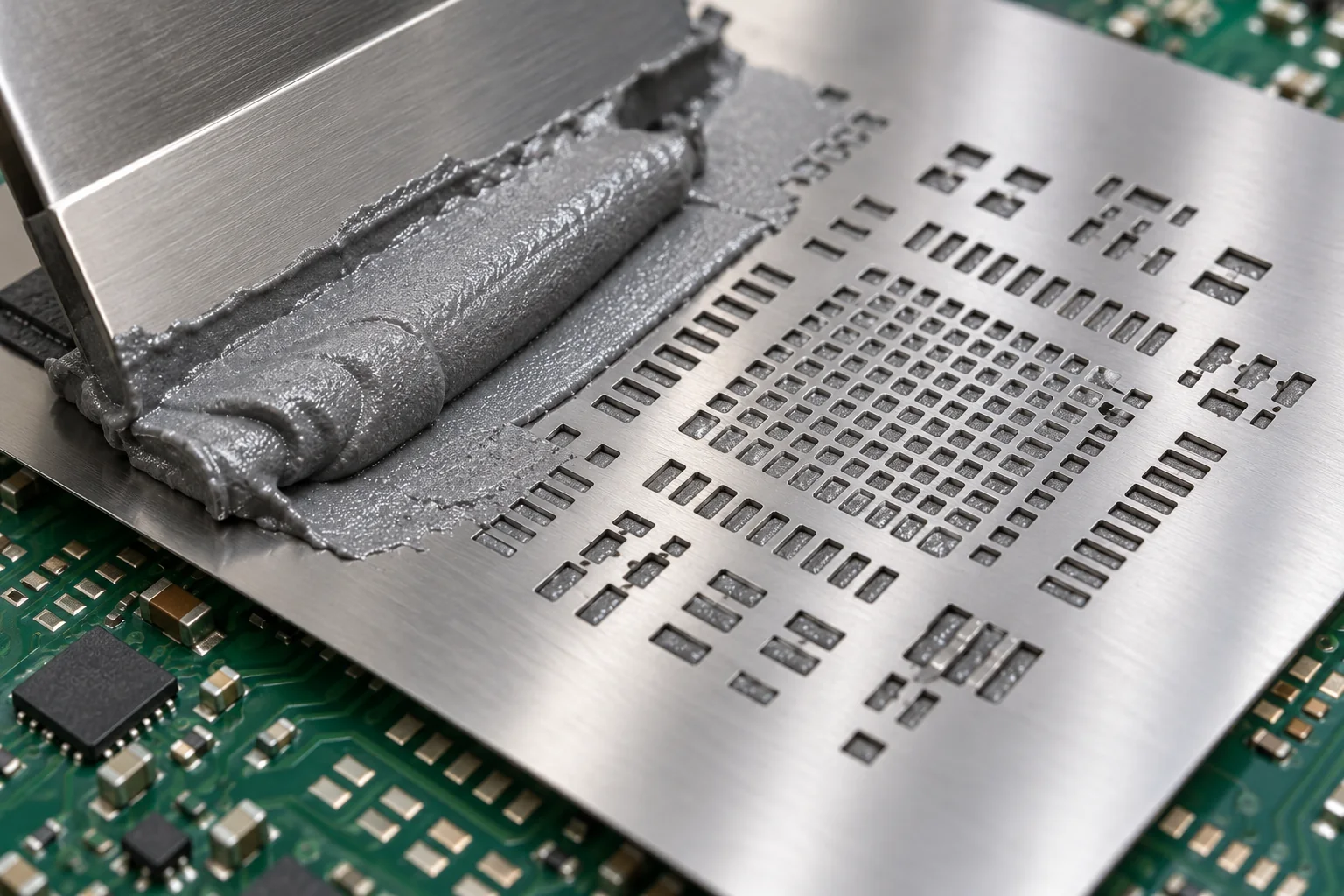
The H10 sheet claims print capability at 0.50AR with T4 and transfer efficiency >90% at that ratio. Keep that statement attached to H10. The sheet does not supply the aperture shape, foil finish, complete test conditions, or production capability statistics behind the claim.
Use it to request supporting qualification evidence for the intended stencil. It is neither a general release threshold nor an acceptance limit for another line. A useful comparison keeps the alloy, formulation, drawing, and evaluation method identifiable so a powder change can be assessed against the same task.
Check graping after the print has passed
A satisfactory wet deposit leaves a separate question: will its particles coalesce during reflow? Indium describes graping as exposed particles oxidizing during heating and failing to join into a uniform mass. The particles left at the surface resemble a cluster of grapes. Smaller deposits and finer powder increase the exposed surface and the oxide burden that the flux must manage.
Inspect the small reflowed deposits for that appearance. Record it separately from the hot-slump and solder-balling failures discussed in the types guide. A successful stencil transfer does not demonstrate that the flux protects the powder throughout heating.
If a finer candidate improves printing but leaves graping, review the formulation and its profile guidance together. The mechanism supports checking oxidation protection; it does not establish that a particular powder class or flux family will solve every case. Keep oven adjustments within the selected paste and assembly limits rather than deriving a recipe from the alloy’s liquidus.
Close the material record before approval
The H10 test summary reports ROL0 under J-STD-004. Record the supplier’s code alongside the alloy and powder. The sheet’s wording “Current Rev” does not identify a standard edition. The flux-class explanation covers how the code relates to the cleaning decision.
Use the following record to separate a documented candidate from an approved process:
- Material: exact paste name, selected alloy and powder, supplier order identity, and TDS revision.
- Alloy: stated composition, labelled solidus and liquidus, and the document supplying them.
- Stencil: drawing reference, named opening, shape, dimensions, foil, and results of the existing guide’s screens.
- Qualification: supplier print evidence with its conditions, results on the intended stencil, and reflowed-deposit observations.
- Open items: unconfirmed availability, missing test conditions, or any specification still needed for the selected product.
Leave metal loading blank unless the exact selected paste specification supplies it. Release the material choice when the order description matches the qualified combination and the unresolved items affecting approval are closed. This reading sequence is an engineering workflow assembled from the cited documents; the supplier claims remain limited to the products and conditions they describe.