Ordering a multi-chip PCIe accelerator simply because the host motherboard has an open x8 or x16 connector can force a chassis rework or waste the evaluation slot if the card fails to enumerate without motherboard PCIe bifurcation or a 254 mm full-length bay. Verify the exact Hailo-8 Century model number (0802S through 0808S), the host slot’s electrical lane wiring and BIOS bifurcation support, the datasheet revision used for mechanical and thermal budgeting, and the software split between model compilation and runtime execution before committing a purchase order.
Hailo’s current Hailo-8 Century product page (modified 14 June 2026, reviewed 17 October 2026) lists nine PCIe card models spanning 52 to 208 TOPS, and their slot requirements are not identical: 0802S specifies a PCIe ×8 slot (68.5 × 130 mm), 0802, 0803, and 0804 specify a PCIe ×16 slot with bifurcation (68.9 × 167.65 mm, 15W–45W Max TDP), and 0804S through 0808S specify a PCIe ×16 slot (68.9 × 254 mm, 45–75W Max TDP). Because Hailo’s earlier August 2023 Rev 1.1 Product Brief PDF prints different dimensions (69 × 168 mm and 111 × 210 mm) and lower Max TDP ranges (10W–25W and 35–65W), teams must bind every host check to the exact ordering SKU and document revision.
| Input or item | What the opened source states | Why it matters |
|---|---|---|
Century SKU family (0802S–0808S) |
Hailo product table (modified 14 June 2026): 9 models from 52 to 208 TOPS across Small form factor (HHHL) and Wide host compatibility (HHFL) |
Slot width, bifurcation requirement, card length, and TDP depend on the exact model suffix |
| Slot and bifurcation boundary | Hailo product table: 0802S uses PCIe ×8 slot; 0802/0803/0804 require PCIe ×16 slot with bifurcation; 0804S–0808S use PCIe ×16 slot |
A broad distributor summary saying “any platform with 8- or 16-lane PCIe slots” does not waive bifurcation on 0802–0804 |
| Document revision delta | Rev 1.1 PDF (08/23) vs. June 2026 web table: 0804S–0808S shift from 111 × 210 mm (35–65W) to 68.9 × 254 mm (45–75W); 0802–0804 shift from 10W–25W to 15W–45W |
Using the older PDF can underestimate chassis length by 44 mm or power budget by 10–20 W |
| Single M.2 module boundary | Hailo M.2 module page: single Hailo-8 (up to 26 TOPS) in Key M (PCIe Gen-3.0, 4 lanes), Key B+M (2 lanes), or Key A+E (2 lanes) |
An M.2 module or third-party carrier is not an official Century SKU |
| Software environment split | Rev 1.1 PDF software diagram: Hailo Dataflow Compiler runs on the Model Build Computer; HailoRT and TAPPAS run on the Host Processor over PCIe |
Target embedded hosts need HailoRT and drivers, not the offline model compiler |
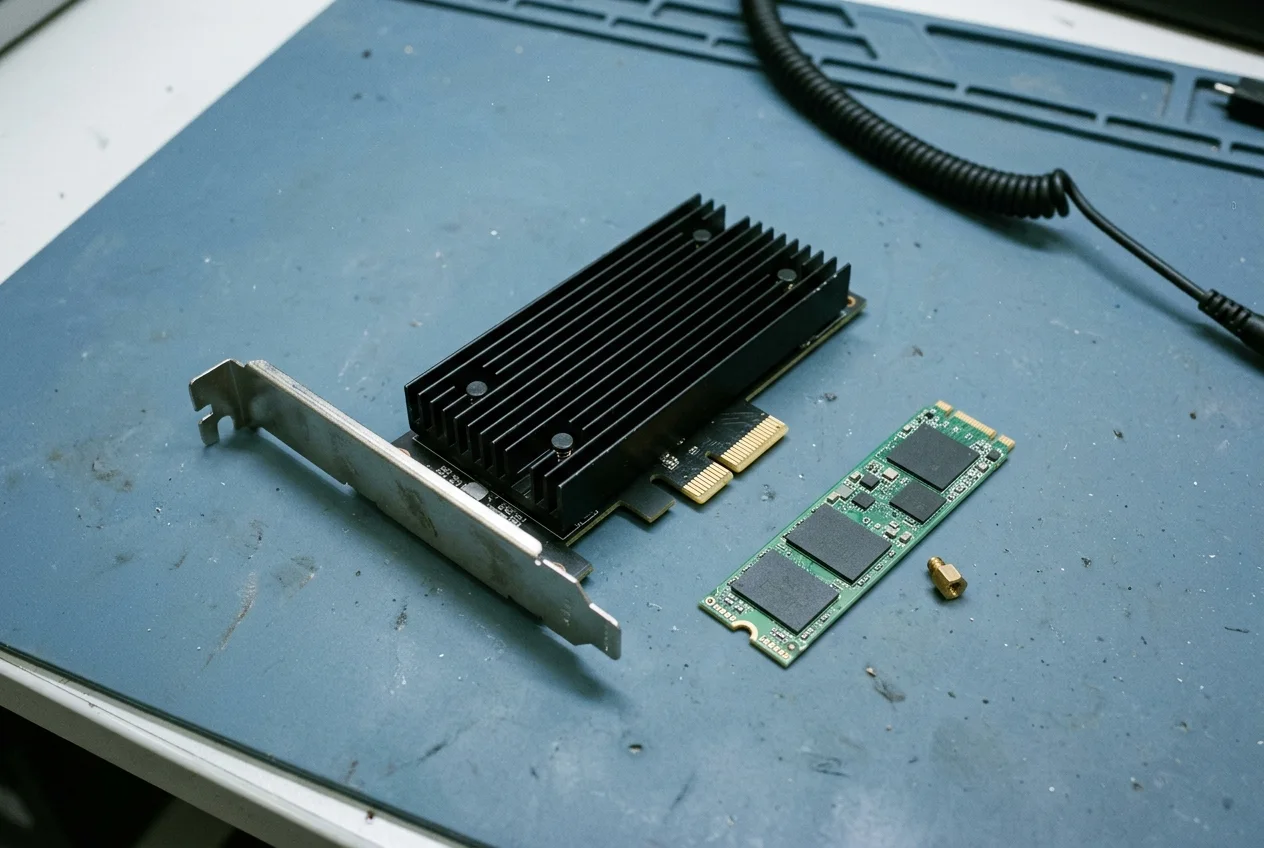
A single-slot PCIe card with a finned heatsink sits beside a narrow green M.2 module and a brass standoff on an anti-static mat.
Are you integrating a Hailo-8 M.2 module, a partner card, or a Century PCIe SKU?
Separate the hardware product boundary before checking motherboard slots. Search results for Hailo-8 PCIe hardware routinely mix single-chip M.2 modules, third-party partner cards, community carrier-board experiments, and factory Hailo-8 Century PCIe cards. Specs from one category do not transfer to another.
| Hardware category | Opened source and date | Stated processor / TOPS and interface | Host integration boundary to preserve |
|---|---|---|---|
Hailo-8 Century PCIe Cards (0802S, 0802, 0803, 0804, 0804S, 0805S, 0806S, 0807S, 0808S) |
Hailo Century product page (modified 14 June 2026) and Rev 1.1 Product Brief (08/23), reviewed 17 October 2026 |
52 to 208 TOPS; PCIe ×8 slot (0802S), PCIe ×16 slot with bifurcation (0802–0804), or PCIe ×16 slot (0804S–0808S) |
Multi-device PCIe expansion cards (15W–45W or 45–75W Max TDP on current table); verify exact SKU and revision |
| Hailo-8 M.2 AI Acceleration Module | Hailo M.2 module page, reviewed 17 October 2026 | Single Hailo-8 processor, up to 26 TOPS; M.2 Key M (PCIe Gen-3.0, 4 lanes, up to 32 Gbs, 22 × 42/60/80 mm), Key B+M (2 lanes, up to 16 Gbs, 22 × 42/60/80 mm), Key A+E (2 lanes, up to 16 Gbs, 22 × 30 mm) |
Single-device M.2 socket module; key notch determines whether the module exposes 4 lanes (Key M) or 2 lanes (Key B+M, Key A+E) |
Advantech EAI-1200 and EAI-3300 partner modules/cards |
Advantech news release, December 2024, reviewed 17 October 2026 | EAI-1200: single Hailo-8 VPU M.2 module (up to 26 TOPS, ~5 W, -40 to 65 °C with optional heatsink). EAI-3300: dual Hailo-8 VPU low-profile PCIe card (52 TOPS, up to 15 W, -40 to 70 °C) |
Advantech-engineered assemblies qualified against named Advantech hosts (ARK-1221L, AIR-150, AFE-R770 for EAI-1200; AIR-510, AIMB-279, ARK-3534D for EAI-3300); not Hailo Century SKUs |
| DIY multi-M.2 NVMe adapter discussions | Hailo Community thread #19237 (4–6 May 2026), reviewed 17 October 2026 |
User inquiry asking how to mount 8× Hailo m.2 (B+M) modules on an off-the-shelf PCIe card to recreate a 208 TOPS Century card |
Forum reply cites either (4x 4x 4x 4x) motherboard bifurcation or a PCIe switch (PLX PEX 8747) and points to a 4-slot M.2 NVMe M-Key card; not a supported Hailo Century BOM |
Two common procurement traps appear in that comparison:
- Do not treat off-the-shelf NVMe M.2 adapter cards as drop-in Century replacements. In the 4–6 May 2026 Hailo Community thread (
#19237), a user holdingHailo m.2 (B+M)modules asked which commercial NVMe PCIe carrier could host eight modules. A community reply (Klaus_Koschinsky, 6 May 2026) noted that unless the motherboard supports(4x 4x 4x 4x)PCIe bifurcation, the carrier needs a PCIe switch, stated “Our Hailo-8 Century card uses a PLX PEX 8747 PCIe switch,” and mentioned a 4-slot M.2 NVMe M-Key controller card found on Amazon Germany. That discussion does not establish an approved multi-module hardware design:Key B+Mmodules expose two PCIe Gen 3.0 lanes (up to 16 Gbs), whereas M-Key NVMe carrier sockets are wired for four-lane M-Key SSDs and carry unverified slot power, cooling, and mechanical constraints. - Do not extrapolate one forum mention of a PCIe switch to all nine Century SKUs. Hailo’s own product table explicitly distinguishes
Small form factormodels that requirePCIe ×16 slot with bifurcation(0802,0803,0804) fromWide host compatibilitymodels that listPCIe ×16 slotwithout a bifurcation qualifier (0804S–0808S). Always check the interface row for the specific Century model number being purchased.
Takeaway: Record whether your BOM calls for a factory Hailo-8 Century PCIe card (0802S–0808S), a single Hailo-8 M.2 module (Key M, Key B+M, or Key A+E), or a third-party partner card (EAI-3300) before evaluating host slot compatibility.
Which Hailo-8 Century SKUs require PCIe bifurcation on the host motherboard?
Check the HTML column spans on Hailo’s current product page (modified 14 June 2026, reviewed 17 October 2026) rather than relying on press-release summaries. An October 2026 supplier-submitted announcement on Electronic Design (published 1 October 2026, fetched 8 October 2026) states that Mouser Electronics is shipping Hailo-8 Century PCIe card starter kits delivering up to 208 TOPS “on any platform with 8- or 16-lane PCIe slots,” and notes that the Hailo-8 processor integrates required memory on-die to eliminate external DRAM. While that summary describes the product family at a high level, the official SKU table sets strict per-model slot and bifurcation rules.
| Century Model | Group header on Hailo table | # of TOPS | Form factor | Interface (June 2026 web table) | Dimensions (June 2026 web table) | Max TDP (June 2026 web table) | Analytics streams (Basic; Advanced) | Stated availability |
|---|---|---|---|---|---|---|---|---|
0802S |
Small form factor | 52 |
single slot, HHHL |
PCIe ×8 slot |
68.5 × 130 mm |
15W-45W |
32; 16 |
Available |
0802 |
Small form factor | 52 |
single slot, HHHL |
PCIe ×16 slot with bifurcation |
68.9 × 167.65 mm |
15W-45W |
32; 16 |
Available |
0803 |
Small form factor | 78 |
single slot, HHHL |
PCIe ×16 slot with bifurcation |
68.9 × 167.65 mm |
15W-45W |
48; 24 |
Available |
0804 |
Small form factor | 104 |
single slot, HHHL |
PCIe ×16 slot with bifurcation |
68.9 × 167.65 mm |
15W-45W |
64; 32 |
Available |
0804S |
Wide host compatibility | 104 |
single slot, HHFL |
PCIe ×16 slot |
68.9 × 254 mm |
45-75W |
64; 32 |
Available by Hailo’s partners |
0805S |
Wide host compatibility | 130 |
single slot, HHFL |
PCIe ×16 slot |
68.9 × 254 mm |
45-75W |
80; 40 |
Available by Hailo’s partners |
0806S |
Wide host compatibility | 156 |
single slot, HHFL |
PCIe ×16 slot |
68.9 × 254 mm |
45-75W |
96; 48 |
Available by Hailo’s partners |
0807S |
Wide host compatibility | 182 |
single slot, HHFL |
PCIe ×16 slot |
68.9 × 254 mm |
45-75W |
112; 56 |
Available by Hailo’s partners |
0808S |
Wide host compatibility | 208 |
single slot, HHFL |
PCIe ×16 slot |
68.9 × 254 mm |
45-75W |
128; 64 |
Available by Hailo’s partners |
Use the table above to separate three distinct host-slot cases:
- Case 1 —
0802S(52 TOPS,Small form factor): The only Century model listed with aPCIe ×8 slotinterface and a shorter68.5 × 130 mmHHHLenvelope on the June 2026 web table. Confirm that your host slot is both mechanically open to accept the card edge and electrically wired with at least 8 active PCIe lanes. - Case 2 —
0802(52 TOPS),0803(78 TOPS), and0804(104 TOPS,Small form factor): All three share thecolspan="3"cellPCIe ×16 slot with bifurcationand the68.9 × 167.65 mmHHHLenvelope. A physical x16 connector that is electrically wired as x8, or a motherboard BIOS that cannot split its x16 root port across multiple endpoints, does not satisfy that requirement. Because the public HTML table statesPCIe ×16 slot with bifurcationwithout printing the exact per-model BIOS lane-split pattern (for example,x8/x8,x8/x4/x4, orx4/x4/x4/x4) inside the table cells, obtain the hardware user guide for the exact starter-kit or card part number from Hailo or your authorized distributor and match that lane map against your motherboard BIOS manual before ordering. - Case 3 —
0804S(104 TOPS) through0808S(208 TOPS,Wide host compatibility): All five models sit under theWide host compatibilityheader, listPCIe ×16 slotwithout a bifurcation requirement in the interface cell, use the longer68.9 × 254 mmHHFLenvelope (45–75WMax TDP), and are markedAvailable by Hailo’s partners. Notice that0804and0804Sboth deliver104 TOPSand64; 32analytics streams, but0804is a shorterHHHLcard requiring motherboard bifurcation (15W–45W), whereas0804Sis a longerHHFLwide-compatibility card (45–75W).
Where do the 2023 Rev 1.1 Product Brief and the current product table disagree?
Do not average numbers or cherry-pick the smaller dimension when two official Hailo documents disagree. Hailo’s downloadable PDF product brief (Hailo-8-Century-PCIe-Product-Brief-Rev1.1.pdf, copyright 08/23) and Hailo’s live product page (modified 14 June 2026, identical in structure on the English and Japanese pages reviewed 17 October 2026) print different model counts, board dimensions, and Max TDP ranges.
| Specification field | 2023 Rev 1.1 Product Brief PDF (08/23) |
Current Web Product Table (modified 14 June 2026) | Verification action before freezing the chassis or PSU |
|---|---|---|---|
Models in Small form factor |
3 models: 0802, 0803, 0804 (0802S not listed) |
4 models: adds 0802S (52 TOPS, PCIe ×8 slot) alongside 0802, 0803, 0804 |
Confirm whether a 52 TOPS quote is for 0802S (PCIe ×8 slot) or 0802 (PCIe ×16 slot with bifurcation) |
Small form factor dimensions |
69 × 168 mm across 0802–0804 |
68.5 × 130 mm for 0802S; 68.9 × 167.65 mm for 0802–0804 |
Check card-guide length and bracket height against the exact mechanical drawing for the ordered SKU |
Small form factor Max TDP |
10W-25W across 0802–0804 |
15W-45W across 0802S, 0802, 0803, 0804 |
Budget slot power and chassis airflow for up to 45 W unless the supplier confirms a lower limit for your exact revision |
Wide host compatibility (0804S–0808S) dimensions |
111 × 210 mm (while labeling Form factor single slot, HHFL) |
68.9 × 254 mm (Form factor single slot, HHFL) |
Resolve the height (111 mm full-height vs. 68.9 mm half-height) and length (210 mm vs. 254 mm) with the partner supplying the card |
Wide host compatibility (0804S–0808S) Max TDP |
35-65W |
45-75W |
Verify PCIe slot 12 V / 3.3 V current delivery and thermal dissipation up to 75 W |
| Heatsink & temperature notes | Footnote: * Products are shipped with a matching heatsink attached; -40°C to 85°C industrial temperature range |
-40°C to 85°C industrial temperature range; room-temperature INT8 evaluation footnote |
Request the required linear airflow (LFM) and ambient temperature derating curve for the attached passive heatsink |
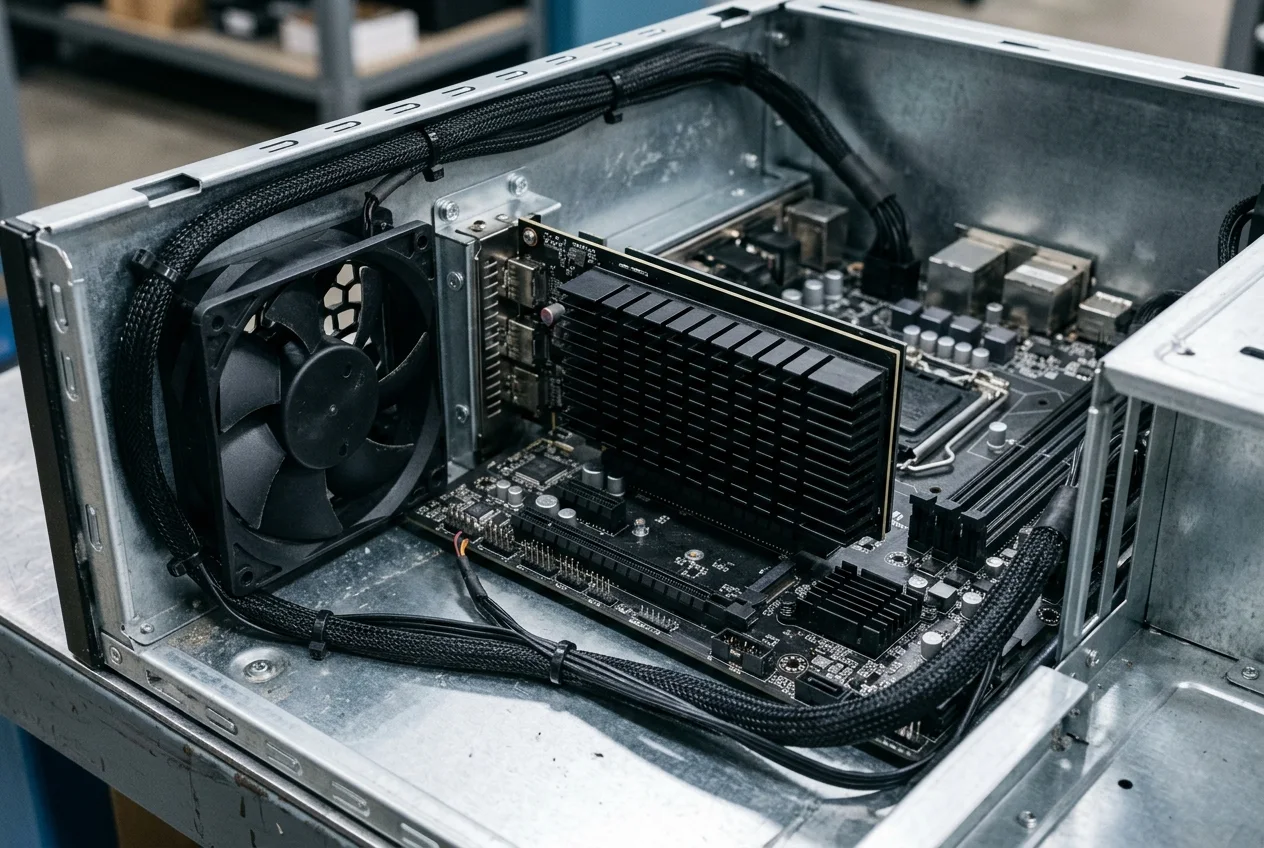
An open industrial chassis shows a PCIe expansion card with a black passive heatsink positioned behind a front chassis intake fan.
Pay particular attention to the 0804S–0808S dimension discrepancy (111 × 210 mm in the 08/23 PDF versus 68.9 × 254 mm on the June 2026 web table). In compact edge servers and industrial PCs, a difference between 68.9 mm (half-height) and 111 mm (full-height) determines whether the card fits a low-profile riser or 2U bay, while an extra 44 mm of card length (254 mm vs. 210 mm) can collide with front intake fans, drive cages, or internal power harnesses. When locking a production BOM, record the vendor document number and revision alongside your component PCN and revision checklist.
Takeaway: Never mix dimensions from the 2023 Rev 1.1 PDF with TDP numbers from the 2026 web table; require the mechanical STEP file or datasheet revision matching the exact manufacturer part number on the quote.
How is software split between the model-build computer and the PCIe host processor?
Separate offline model compilation from target host runtime deployment. Page 2 of Hailo’s Rev 1.1 Product Brief (08/23) illustrates a Comprehensive Software Suite divided into two distinct computing environments: the Model Build Environment (Model Build Computer) and the Runtime Environment (Host Processor connected over PCIe to Hailo-8™ Century).
| Environment | System role in Hailo’s Rev 1.1 diagram | Software components listed in opened Hailo sources | What the team must verify before deployment |
|---|---|---|---|
| Model Build Environment | Model Build Computer (offline development workstation/server) |
Model Zoo (TensorFlow & ONNX pre-trained and retrainable models), Machine Learning Frameworks (TensorFlow, TensorFlow Lite, Keras, PyTorch, & ONNX), User Models, and Hailo Dataflow Compiler (optimizes and translates trained models to Hailo-8™ format) |
Workstation OS/hardware requirements for the Hailo Dataflow Compiler, target model operator support, and INT8 quantization accuracy on your own dataset |
| Runtime Environment (Host side) | Host Processor (target PC, edge server, or industrial computer with PCIe slot) |
User Applications, TAPPAS (full application examples implementing pipeline elements and pre-trained AI tasks), OS IP Stack, and HailoRT (production-grade, precompiled runtime software for the host processor); Supported OS listed as Linux, Windows-10 / 11 |
Exact Linux distribution/kernel version or Windows build, PCIe driver compilation/signing, HailoRT version, and multi-chip scheduling across all onboard Hailo-8 devices |
| Runtime Environment (Card side) | Hailo-8™ Century across the PCIe bus |
Hailo-8™ Firmware executing on the card’s Hailo-8 processors |
Firmware version match with the installed HailoRT release and PCIe link enumeration (lspci / Device Manager) for every onboard processor |
An open host unit with a heatsink-equipped card, rear I/O cables, a small camera housing, and a closed laptop on a test bench.
That architectural boundary prevents two common software mistakes during host evaluation:
- Do not size the embedded PCIe host around the
Hailo Dataflow Compiler. Model translation toHailo-8™ formathappens in theModel Build Environment. The targetHost ProcessorrunsHailoRT,TAPPASpipeline elements, andUser Applicationscommunicating overPCIewithHailo-8™ Firmware. - Do not treat
Linux, Windows-10 / 11or framework names as proof of plug-and-play application readiness. Just as we noted in the NXP Ara240 chip and M.2 module integration checklist—where Ara240’s own runtime and model constraints apply only to NXP’s hardware and never transfer to Hailo-8—PCIe device enumeration, runtime service initialization, and compiled-model throughput are separate acceptance gates. On a multi-chip Century card (52to208 TOPS), enumeration is only complete when the host OS detects the expected number of Hailo-8 endpoints across the PCIe link. If low-level board bring-up or reset behavior is also under review on a custom host, keep those hardware checks separate using the JTAG vs SWD debug checklist and the STM32 watchdog reset verification log.
What should you record on the host compatibility worksheet before purchasing?
Copy this verification table into your engineering review before ordering a Hailo-8 Century starter kit or partner card. Keep Unknown / verify on the unit in every row until the distributor, partner, or host manual provides the specific evidence for your SKU.
| Check item | What to record from your quote and host manual | Default status until documented | Who confirms it |
|---|---|---|---|
| Exact hardware identity | Full ordering part number, Century model (0802S, 0802, 0803, 0804, 0804S, 0805S, 0806S, 0807S, or 0808S), and datasheet revision date |
Unknown / verify on the unit |
Hailo, authorized distributor (such as Mouser), or Hailo partner |
| Physical slot & electrical lanes | Host slot mechanical size (x8 or x16), active electrical lane count, and PCIe generation |
Unknown / verify on the unit |
Host motherboard or industrial PC vendor |
| PCIe bifurcation or onboard switch | For 0802/0803/0804: required BIOS bifurcation lane-split map and motherboard BIOS support on that exact slot; for 0804S–0808S or 0802S: partner confirmation that host bifurcation is not required |
Unknown / verify on the unit |
Card supplier (lane map) and host motherboard manual (BIOS setting) |
| Mechanical envelope | Confirmed card height and length (68.5 × 130 mm, 68.9 × 167.65 mm, 68.9 × 254 mm, or Rev 1.1 69 × 168 mm / 111 × 210 mm), bracket height (HH vs. FH), and single-slot clearance |
Unknown / verify on the unit |
Card mechanical drawing and chassis CAD check |
| Power and thermal budget | Applicable Max TDP (15W–45W or 45–75W on June 2026 table vs. 10W–25W or 35–65W in Rev 1.1 PDF), PCIe slot power delivery limit, and required chassis airflow across the attached passive heatsink |
Unknown / verify on the unit |
Card thermal guide and chassis/PSU spec sheet |
Host OS and HailoRT match |
Target OS (Linux kernel/distro or Windows 10 / 11 version), matching HailoRT driver/firmware version, and expected endpoint count in lspci / Device Manager |
Unknown / verify on the unit |
Software integrator using Hailo release notes |
| Model build & pipeline gate | Target model compiled via Hailo Dataflow Compiler on the build computer, plus end-to-end throughput/latency criterion on the host (Basic vs. Advanced analytics stream definition is not stated in the public table) |
Unknown / verify on the unit |
Application AI team |
Hailo’s product page also cites 400 FPS/W in ResNet50 benchmark model and 32; 16 to 128; 64 Analytics streams (Basic; Advanced), with a footnote stating that evaluation platform figures are measured at room temperature for INT8. Treat those figures as vendor benchmark statements under room-temperature INT8 evaluation conditions, not guaranteed frame rates for your camera resolution, model graph, or enclosure ambient temperature.
Method and sources
Reviewed on 17 October 2026 from opened primary documents: Hailo’s English and Japanese Hailo-8 Century product pages (modified 14 June 2026), Hailo’s downloadable Hailo-8-Century-PCIe-Product-Brief-Rev1.1.pdf (08/23), Hailo’s Hailo-8 M.2 AI Acceleration Module specification page, Hailo Community thread #19237 (4–6 May 2026), Advantech’s December 2024 EAI-1200 / EAI-3300 announcement, and the supplier-submitted Mouser / Electronic Design announcement (published 1 October 2026, archived in the research library on 8 October 2026). Column assignments for the nine Century SKUs were verified directly from the HTML colspan attributes of Hailo’s product table rather than inferred from flattened text.
No Hailo-8 Century card, M.2 module, NVMe carrier, or host motherboard was physically tested for this guide, and no independent frame-rate, power, or thermal measurements were taken. Bench photographs show generic hardware integration contexts and do not depict a named Hailo or partner assembly. Browse more hardware checklists in the Embedded Systems section or the complete article index.