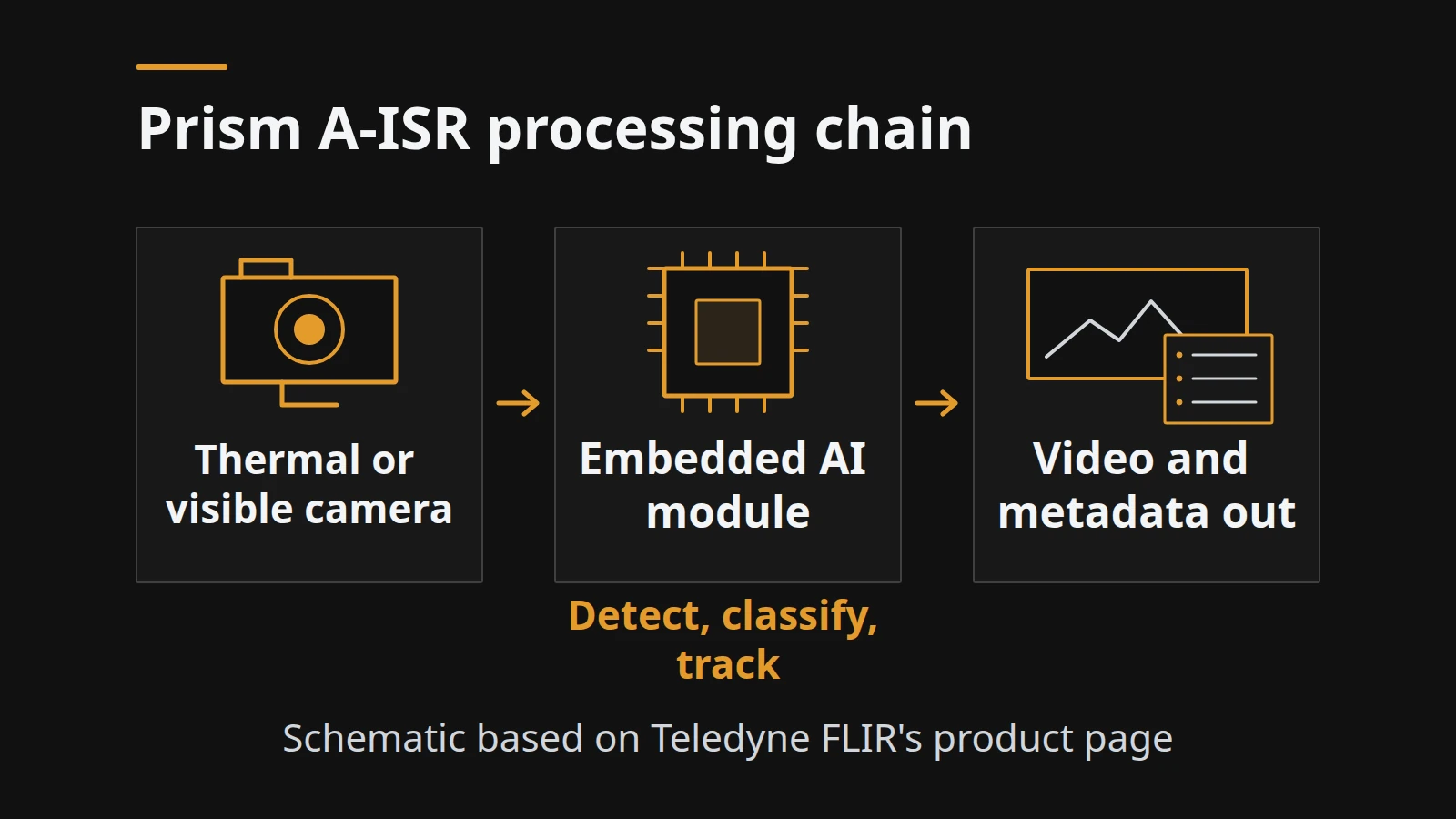
Choosing an airborne AI software stack before checking its compute, camera and power requirements can cost a payload redesign. Teledyne FLIR’s Prism A-ISR, announced on 6 October 2026, lists only NVIDIA Orin NX/AGX and Qualcomm 8550 as compute platforms, native support for Boson+, Boson SX8, Neutrino LC and Neutrino SX8 cameras, and a power figure under 12 W average and 15 W maximum.
What is confirmed: the product page for model 110-0201-92 lists the specifications below and marks the product “In Production”; DRONELIFE reported the announcement on 6 October 2026. All specs are Teledyne FLIR’s own; the sources we reviewed contain no independent test results. What the sources we checked do not give: the list of supported third-party cameras, pricing and licensing, export classification, detection ranges and false-alarm data, and what exactly the power figure measures.
- Prism A-ISR detects, classifies and tracks ground objects (people, vehicles, boats) from infrared and visible cameras on uncrewed and other aircraft.
- Deliverables are a GUI, an SDK with the solution package, technical documentation and a sample C++ reference application.
- Teledyne FLIR will demonstrate it at the AUSA Annual Meeting on 12–14 October 2026, according to DRONELIFE.
What did Teledyne FLIR announce?
Teledyne FLIR announced Prism A-ISR, AI software for real-time detection, classification and tracking of ground objects from uncrewed aircraft systems and other airborne platforms, built to run at the edge on embedded AI hardware. The timeline separates the dated event from the undated product page.
| Date | Event | Source | Source type |
|---|---|---|---|
| Not shown | Product page for model 110-0201-92, marked “In Production” | Teledyne FLIR OEM | Manufacturer |
| 6 October 2026 | Announcement reported | DRONELIFE | Trade media, based on the company announcement |
| 12–14 October 2026 | Planned demonstration at the AUSA Annual Meeting, Washington, D.C. | DRONELIFE | Single report |
The product page names persistent surveillance, force protection and intelligence missions as uses, and says new object classes can be produced with Teledyne FLIR’s AIMMGen synthetic model-training service. DRONELIFE quotes the company as saying AIMMGen creates updated mission models in days rather than weeks; that is a company claim without published conditions.
This is a single-company announcement, so every figure below is labelled as the manufacturer’s; we handle Emerson’s analyzer announcement the same way, separating announced status from verified status.
Takeaway: Treat the product page as the specification source and the press report as the event record.
Which compute, camera and power specs are published?
The published integration specs cover two compute families, four native thermal cameras plus typical 4 MP UVC EO cameras, a power figure and three video outputs. The table lists them as given on the product page.
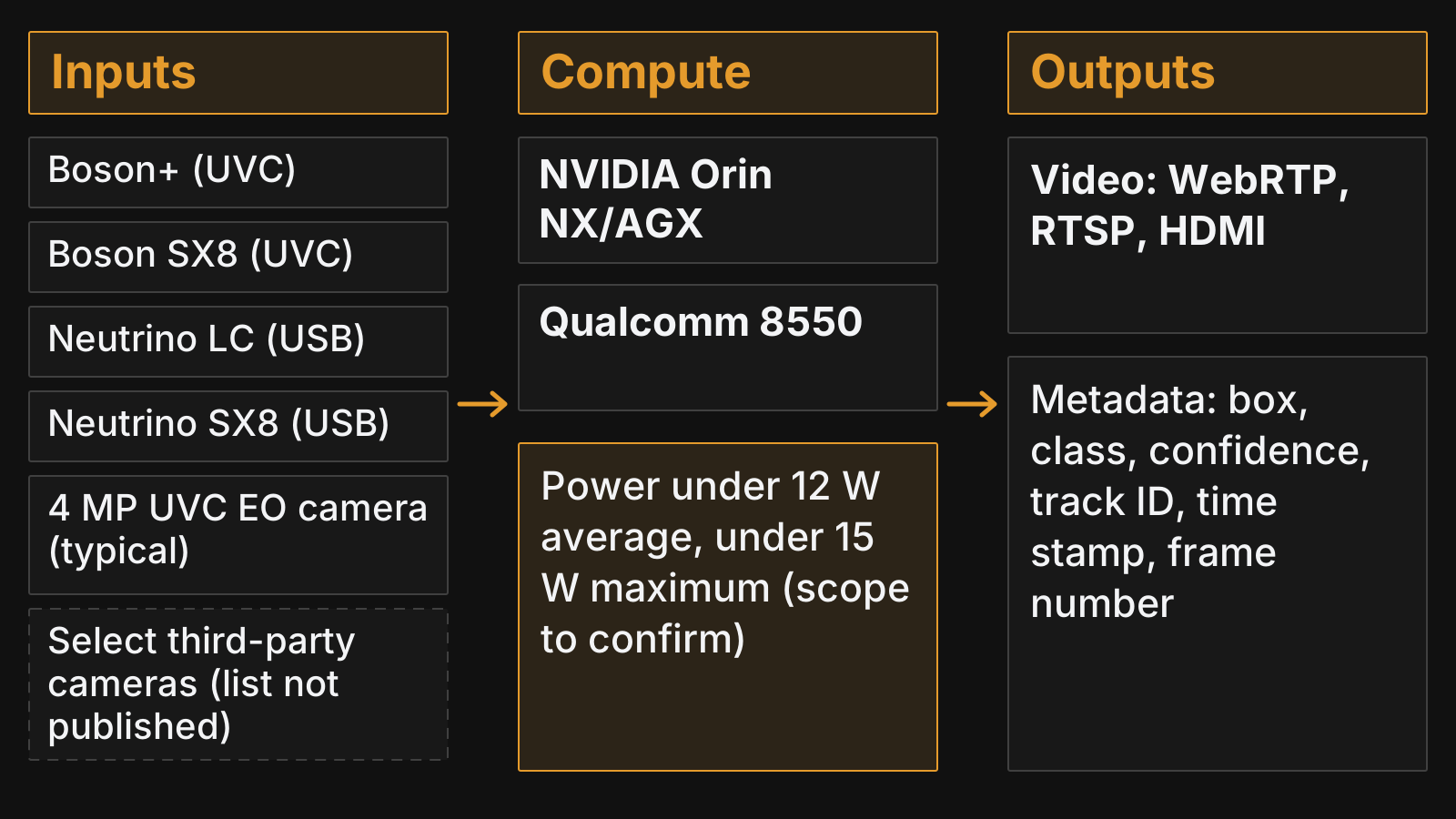
Figure 1. Published inputs, compute platforms and outputs. Schematic based on the product page.
| Item | Published value | Note |
|---|---|---|
| Compute hardware | NVIDIA Orin NX/AGX, Qualcomm 8550 | No other platforms listed |
| Native IR cameras | Boson+ (UVC), Boson SX8 (UVC), Neutrino LC (USB), Neutrino SX8 (USB) | Fixed focal length and continuous zoom configurations supported |
| IR data | 14-bit LWIR and MWIR; 640 × 512 and 1280 × 1024 | — |
| EO camera | 4 MP with UVC input typical | Larger formats affect frame rate |
| Third-party cameras | “Select” IR and EO cameras | Models not listed |
| Inference time | About 10 ms | Conditions not stated |
| Power | Under 12 W average, under 15 W maximum | Listed under system requirements; what is measured is not stated |
| Video output | “WebRTP”, RTSP, HDMI | Confirm the exact protocol name |
| Image filters | Denoise, super resolution, electronic stabilization (plus dehaze in the feature list) | — |
| Deliverables | GUI, SDK with solution package, technical documentation, sample C++ reference application and libraries | — |
Two entries need a question before they go into a design. The power figure sits under system requirements without saying whether it covers the compute module, the software load or the whole payload, so it cannot yet be used for a power budget on its own. The video output list includes “WebRTP”, which is not a protocol name we recognise; it may refer to WebRTC, but ask Teledyne FLIR to confirm.
Our profileGAUGE C.ODC integration notes show the same exercise of pairing each spec with its condition for an industrial sensor.
Takeaway: Confirm what the power figure covers and which video protocol is meant before you size the payload.
How to read the detection and tracking specs
Read the detection and tracking figures as thresholds with conditions, not as performance results: the 60% classification figure needs at least 10 × 10 pixels on target, and 16 tracked targets is a default, not a limit. None of the published numbers is a detection range or a false-alarm rate.
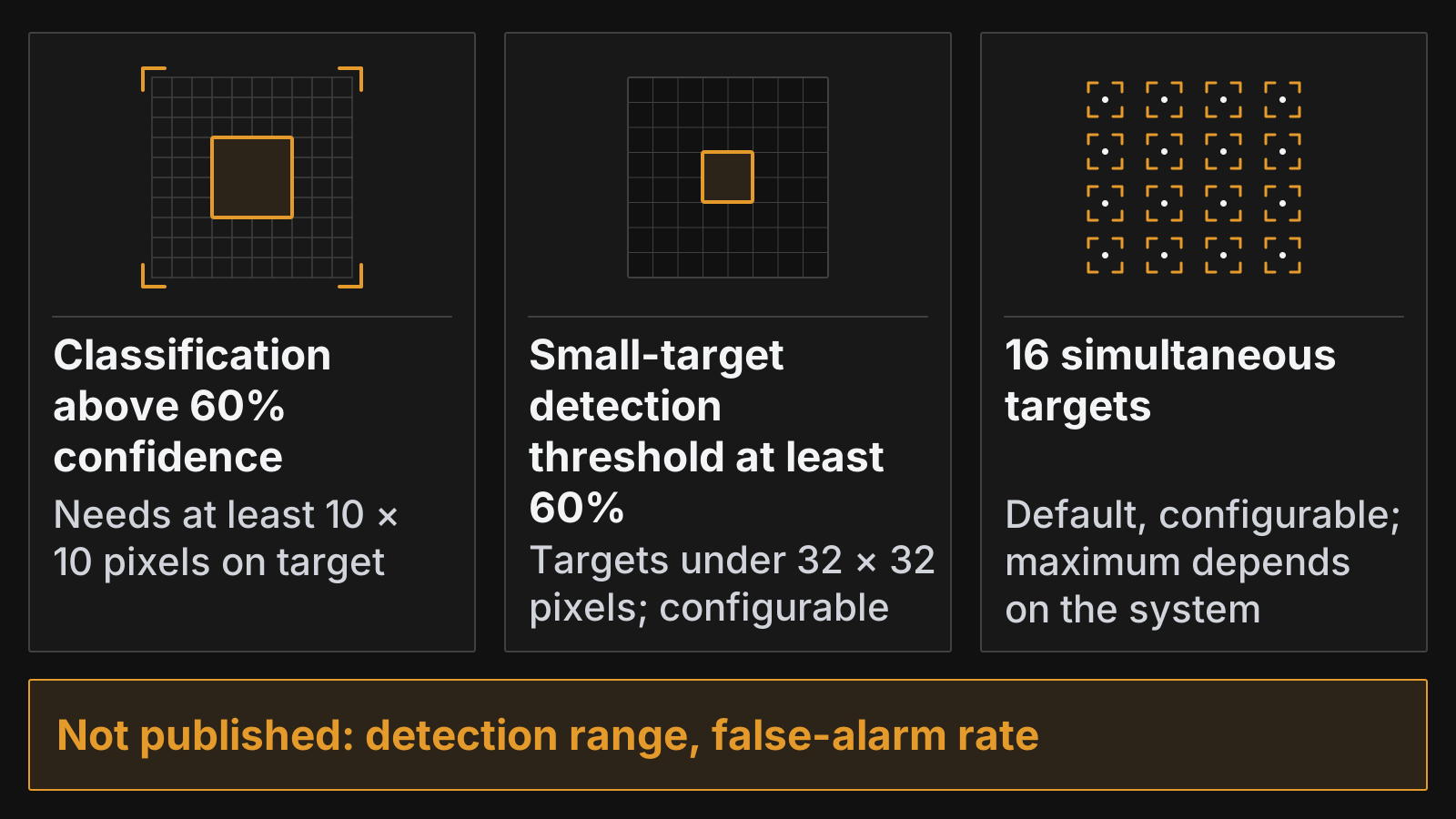
Figure 2. What each published detection figure means, and what it does not say.
| Published figure | Condition | What it does not tell you |
|---|---|---|
| Object classification above 60% confidence | At least 10 × 10 pixels on target (minimum) | Range at which a target reaches 10 × 10 pixels on your lens |
| Detection confidence threshold of at least 60% | Small targets under 32 × 32 pixels; configurable | False-alarm rate at that threshold |
| 16 simultaneous targets | Default; configurable; maximum depends on the system | The maximum on your hardware |
| Object classes | Person, vehicle (car, bus, truck, van, construction), boat | Performance per class |
| Metadata | Bounding box area and location, category ID, class label, confidence, time stamp, track ID, frame number | Output format and transport |
The pixel condition is the most useful number for integration. With the target’s real size, your sensor resolution and your lens, you can estimate the distance at which a target still covers 10 × 10 pixels. That is a geometric minimum, not a verified classification range or a confidence guarantee; the product page publishes no ranges or test conditions.
Teledyne FLIR also says its denoise and super-resolution processing extends detection range and reduces false alarms and bit rate. No figures are given, so treat these as claims to test, and record each figure with its stated configuration, as our HARTING connector notes do for space and weight claims.
Common mistake: Quoting “60% confidence” or “16 targets” without their conditions. Classification confidence above 60% is listed with at least 10 × 10 pixels on target; the separate small-target detection threshold is at least 60% and configurable; 16 is a configurable default.
Takeaway: Use the pixel condition to plan your tests, and ask Teledyne FLIR for the test conditions behind each figure.
Embedded integration checklist
Use this checklist to turn the published specs into an evaluation record. Each row says what the product page gives and what to ask Teledyne FLIR for.
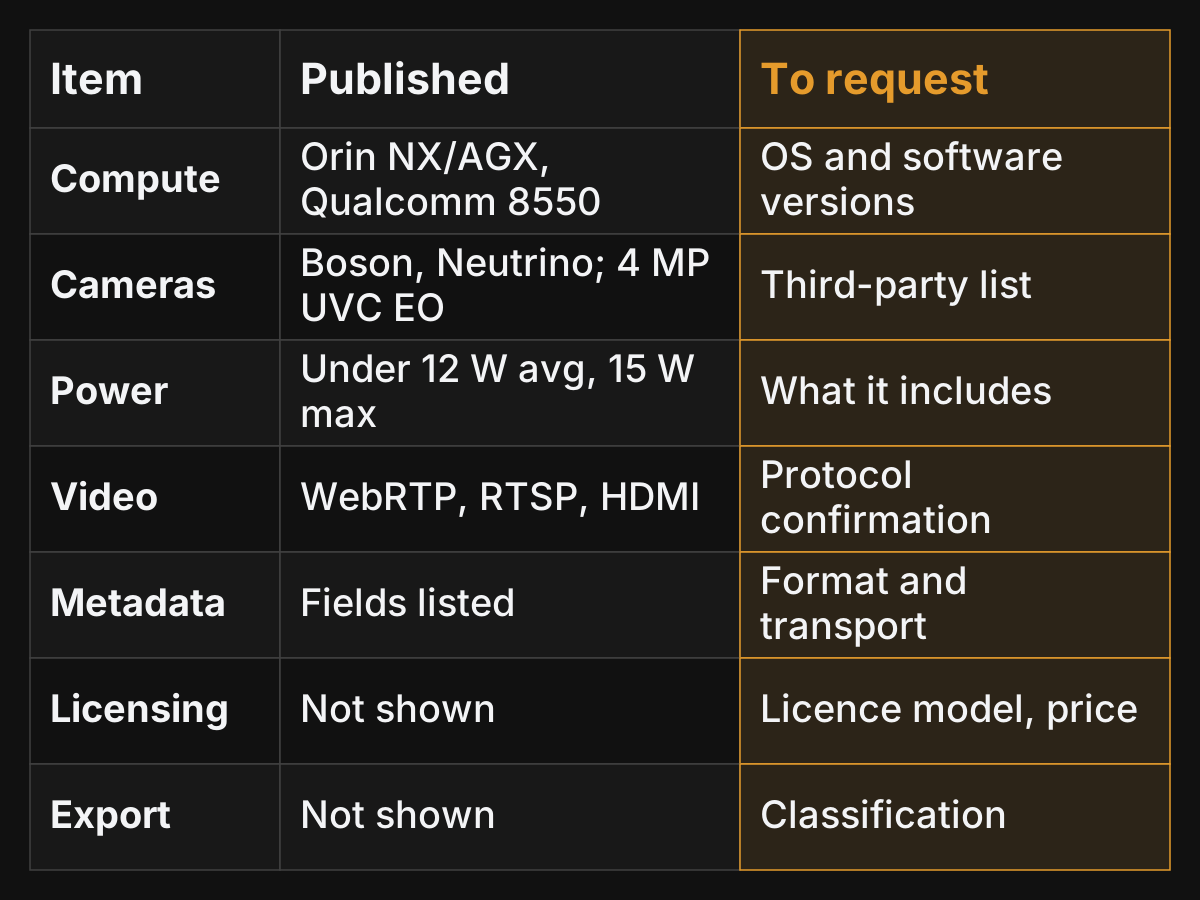
Figure 3. Integration checklist: published items and items to request.
| Item | Published | To request |
|---|---|---|
| Compute platform | Orin NX/AGX, Qualcomm 8550 | Supported OS and software versions for your module |
| Camera and interface | Boson+, Boson SX8 (UVC); Neutrino LC, SX8 (USB); 4 MP UVC EO typical | Third-party camera list and how they are qualified |
| Power budget | Under 12 W average, under 15 W maximum | What the figure includes |
| Video output | “WebRTP”, RTSP, HDMI | Protocol confirmation, latency and bit-rate settings |
| Metadata | Fields listed above | Output format, transport and SDK interface |
| SDK and documentation | GUI, SDK, technical docs, C++ reference app | Datasheet and documentation set |
| Licensing and price | Not shown | Licence model and pricing |
| Export classification | Not shown | Classification for your programme |
If the payload or its ground station also feeds an industrial control network, the profileGAUGE C.ODC readiness checklist shows the fieldbus documents and connections to collect.
Takeaway: Fill in the “To request” column before committing a payload design to Prism A-ISR.
Who is affected?
The product is aimed at integrators and OEMs building airborne ISR payloads on Teledyne FLIR’s Boson and Neutrino thermal cameras and NVIDIA Orin or Qualcomm 8550 compute, mainly for defence missions such as persistent surveillance and force protection.
| Reader | What changes | Basis |
|---|---|---|
| UAS payload integrators on Orin or 8550 | A packaged detection and tracking stack with SDK | Product page |
| Teams using Boson or Neutrino cameras | Native camera support | Product page |
| Teams using other cameras | Support depends on an unpublished list | Product page |
| Programme and compliance staff | Licensing, export and NDAA questions open | Product page; DRONELIFE |
Takeaway: Integrators already on the listed hardware gain the most; others start with the compatibility questions.
When to act
Request documents and an evaluation now; design commitments wait for licensing, export and compatibility answers.
| When | Action | Status |
|---|---|---|
| Now | Request datasheet, SDK documentation and the third-party camera list | Ask Teledyne FLIR |
| 12–14 October 2026 | AUSA Annual Meeting demonstration, Washington, D.C. | Reported by DRONELIFE |
| Before design commitment | Confirm licensing, pricing and export classification | Not shown in the sources we checked |
| Before flight testing | Measure detection and tracking on your own camera, lens and platform | Your test plan |
Takeaway: Use the demonstration and documents to evaluate; commit only after the open items are answered.
What is still unconfirmed?
The items that decide an integration are the supported third-party cameras, licensing and price, export classification and real detection performance. Each lists who can confirm it.
- Third-party camera list: not on the product page. Teledyne FLIR; ask for the compatibility list.
- Pricing and licence model: not shown. Teledyne FLIR; ask for the licence terms.
- Export classification: not stated in the sources we checked. Teledyne FLIR and your export compliance staff; ask for a written classification.
- NDAA position of the software: the report’s NDAA statement concerns the cameras only; as with part-level connector certificates, a statement about one component does not cover the system. Teledyne FLIR.
- Detection range and false-alarm rate: not published. Your own tests, or a Teledyne FLIR performance report with test conditions.
- AIMMGen turnaround: “days rather than weeks” is a company claim. Teledyne FLIR, with conditions.
- Product page date and datasheet contents: not shown. Teledyne FLIR.
Takeaway: Put these seven items into your request for information.
Our reading
For integrators already on Orin or Qualcomm 8550 with Boson or Neutrino cameras, Prism A-ISR offers a packaged stack with defined inputs, outputs and metadata, which can shorten software integration. The performance claims are unquantified, and the power and protocol entries need clarification. More embedded hardware and software coverage is in our embedded systems section, and related industrial integration notes are in our industrial electronics section. This independent site has no connection with Teledyne FLIR; all our explainers are listed on the blog index.
Takeaway: Evaluate it as a component with a published interface, and test the performance yourself.
When this does not apply
This page covers integration planning for Prism A-ISR as published by 7 October 2026. It does not apply to:
- Other Prism products such as C-UAS, Ground ISR or SKR, which have their own pages.
- Public safety or civilian search and rescue uses, which the sources do not describe.
- Operational effectiveness claims, which need test data that is not published.
Takeaway: Use this checklist for airborne ISR integration planning only.
Method and sources
Compiled on 7 October 2026 from Teledyne FLIR’s OEM product page for model 110-0201-92 and DRONELIFE’s report of 6 October 2026. The datasheet PDF linked from the product page was not reviewed. We did not test the software. We will update this page if Teledyne FLIR publishes a camera list, pricing or performance data.
Takeaway: Every specification here is Teledyne FLIR’s; check it against the current datasheet before use.
Related reading
These pages are in other categories but cover the same evaluation steps.
- profileGAUGE C.ODC integration notes — See a full document and wiring checklist for a fieldbus sensor.
- Emerson QX1400 certification tracker — Separate announced, expected and verified status for a new product.
- HARTING Han Size 4 explainer — Match each vendor figure to the configuration it was stated for.