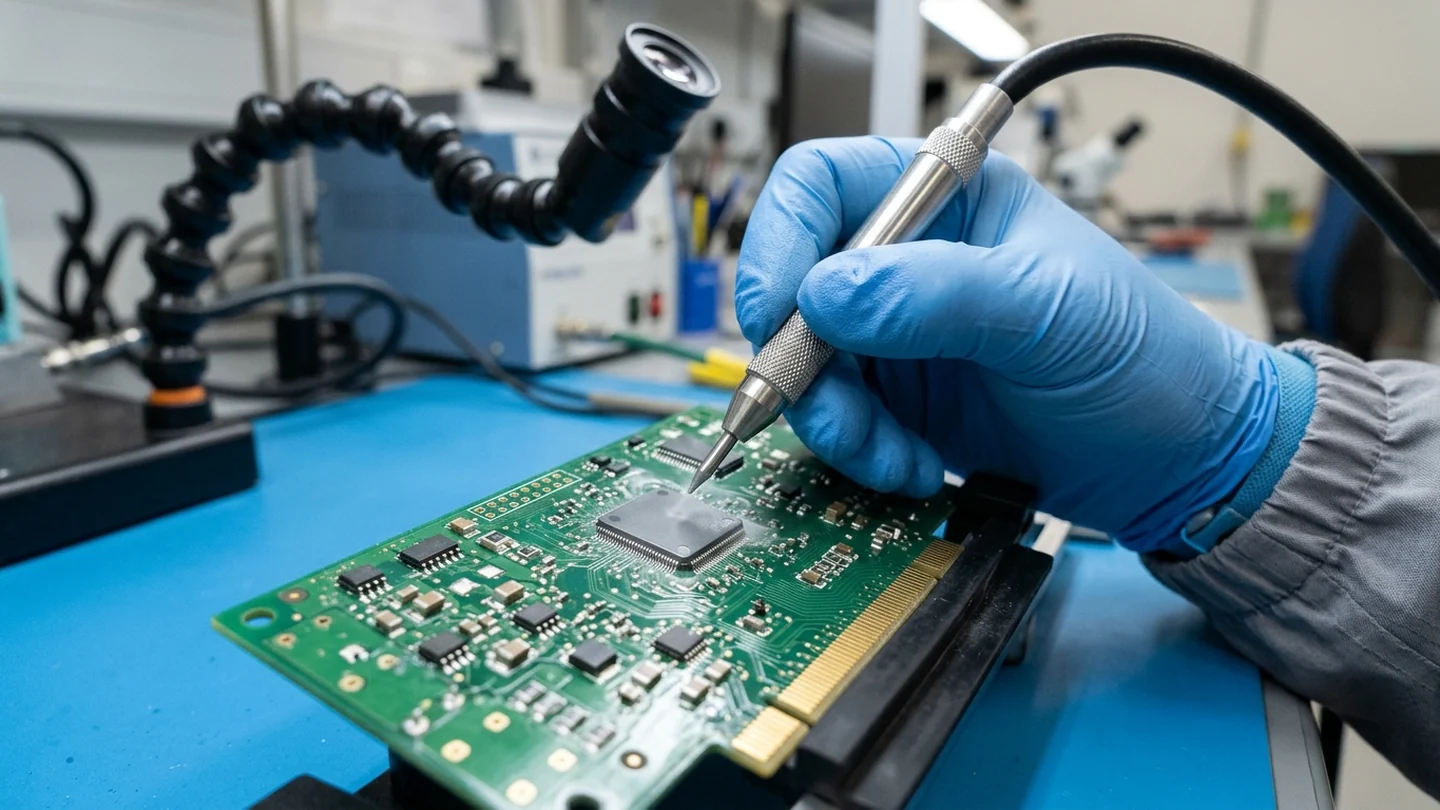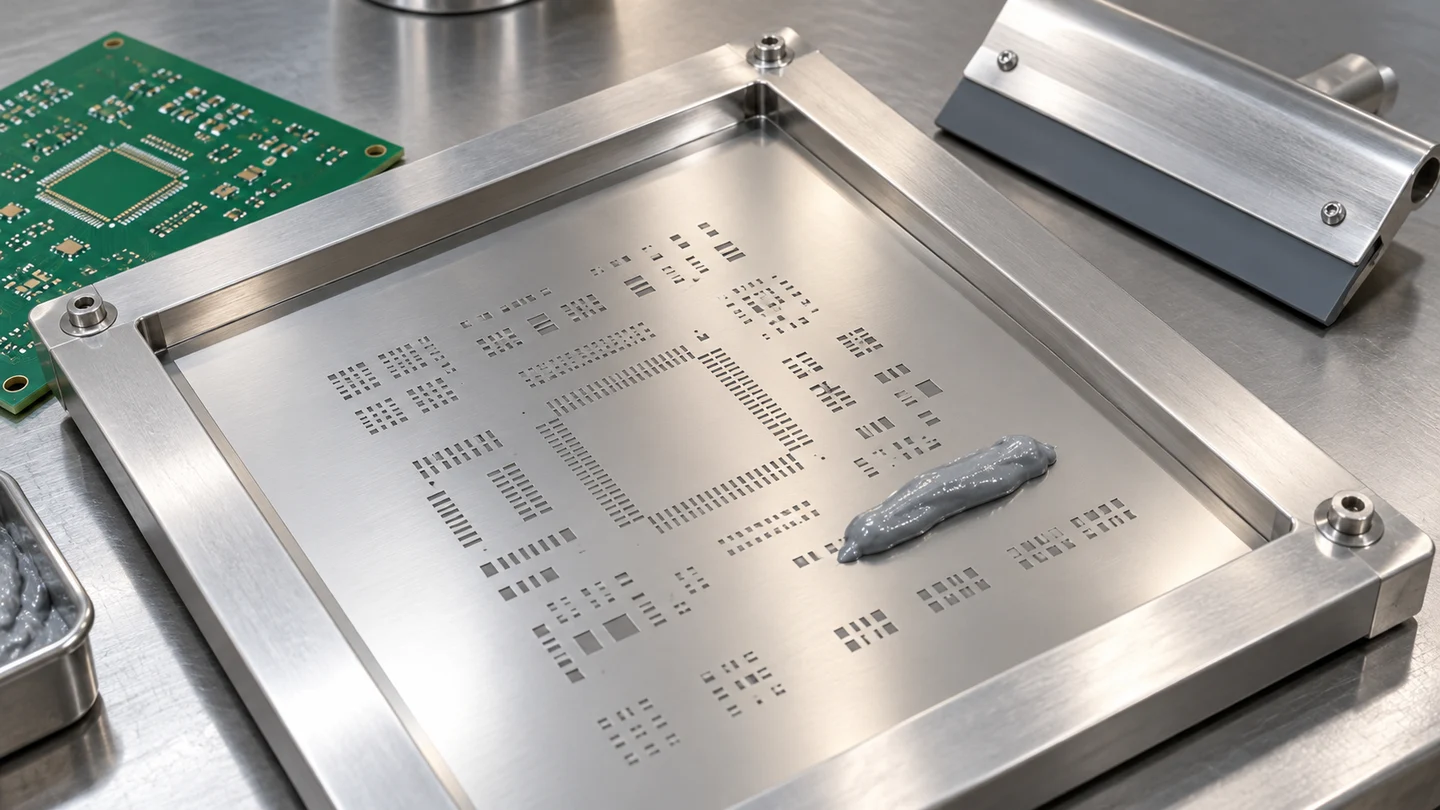
Conformal coating is defined in IPC-HDBK-830A as a thin, transparent, polymeric coating applied to the surfaces of printed circuit assemblies (PCAs) to provide protection from the end-use environment. Typical conformal coating thickness in IPC-HDBK-830A ranges from 12.5 µm [0.49 mil] to 200 µm [7.9 mil]. Processing characteristics and curing mechanisms depend on the coating chemistries used, and desired performance characteristics depend on the application.
Specifying a selective conformal coating machine for electronics manufacturing requires matching applicator fluid delivery to liquid viscosity, solids by volume, and keep-out boundaries around unmasked connectors. For base resin family comparisons and rework stripper selection, see our companion guide on conformal coating for PCBs, thickness and rework.
How Valve Atomization Matches Coating Viscosity and Edge Definition
When matching valve choice to board geometry in selective conformal coating, HumiSeal advises using spray for broader coverage, film coat for more uniform stripes, and jet or needle dispense for tight features and sharper boundaries. Supported fluid delivery methods on the Select Coat SL-940 Series include the Select Coat SC-280 Film Coater, SC-300 Multi-Mode applicator, SC-350 Select Spray applicator, and SC-400 PreciseCoat conformal coating jet.
Non-Atomized Film Coaters: Nordson ASYMTEK SC-280 and PVA FC100-CF
The Select Coat SC-280 Film Coater provides automated, selective application of low-viscosity conformal coatings below 125 cP. With a transfer efficiency of virtually 100%, the Select Coat SC-280 Film Coater improves material utilization by 30-50%, and its non-atomized design minimizes overspray, masking, and rework. The Select Coat SC-280 Film Coater supports wet coating thicknesses of 12.5 to 100 µm (0.5 to 4 mils) for solvent-based materials and 100 to 250 µm (4 to 10 mils) for 100% solids formulations.
In the Select Coat SC-280 Film Coater specifications table, Film Pattern Width is 6 to 19 mm (0.24 to 0.75 in.), Masking is not required, and Material Viscosity is under 100 cPs. In the Select Coat SC-280 Film Coater specifications table, Application Thickness for solvent-based materials is 10 to 76 µm (0.0004 to 0.003 in.) and Edge Tolerance is ±0.75 mm (± 0.03 in.). In the Select Coat SC-280 Film Coater specifications table, Transfer Efficiency is over 99%, Coating Velocity is up to 750 mm/sec (up to 30 in./sec), and Fluid Dispense Pressure is 100 to 410 kPa (15 to 59 psi). The Select Coat SC-280 Film Coater is available in a non-circulating configuration and a circulating configuration with closed-loop temperature management for viscosity stability.
The PVA FC100-CF non-atomized film coating valve provides a non-atomized coating process with superior edge definition and 99% transfer efficiency. The PVA FC100-CF non-atomized film coating valve specifies a coating process speed up to 500 mm/sec (19,7 in/s), a pattern width of 8-12 mm, and a viscosity range of 1 – 100 cps. The PVA FC100-CF non-atomized film coating valve specifies an air pressure of 60 to 100 psi and a maximum inlet fluid pressure of 3500 psi.
Multi-Mode Swirl Applicators: Nordson ASYMTEK SC-300
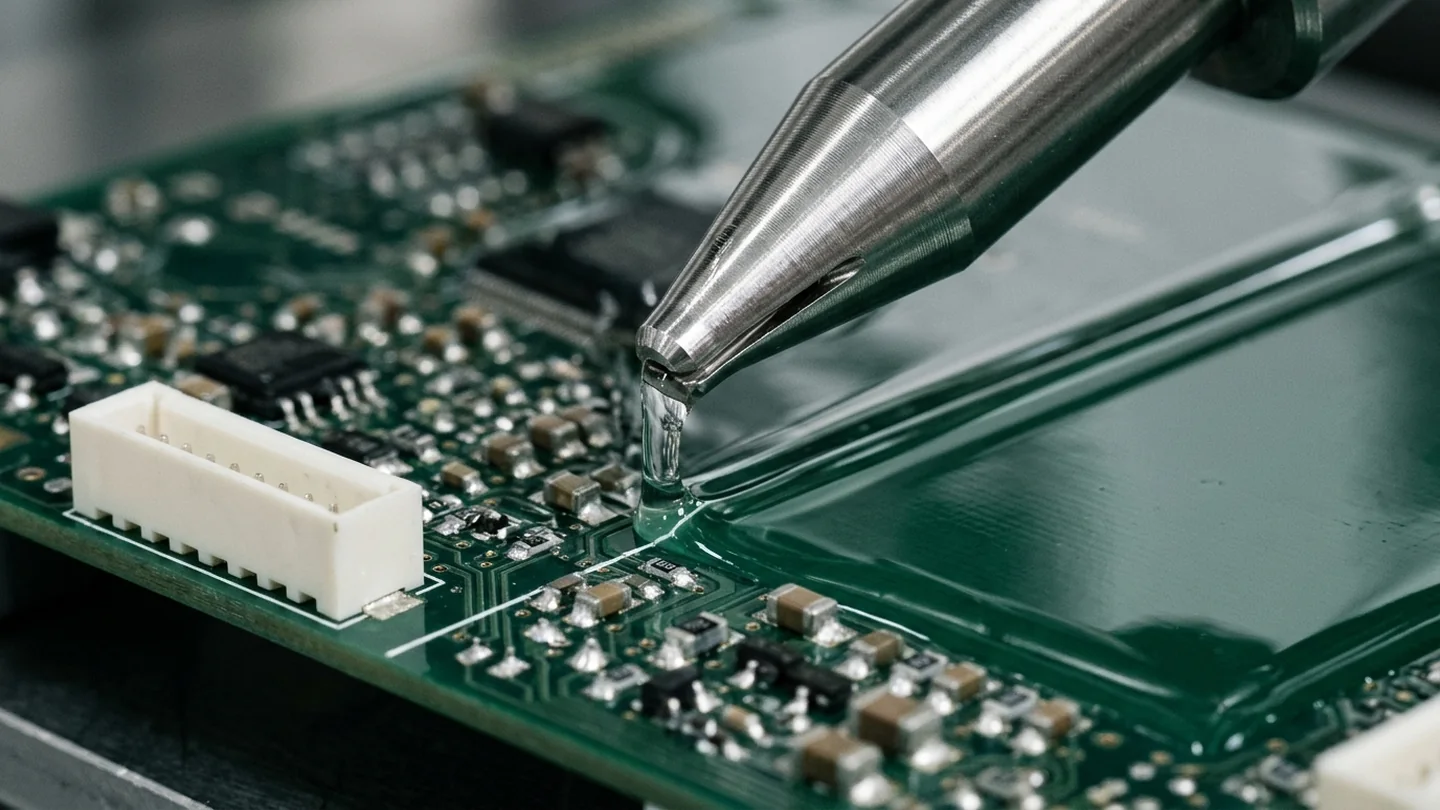
The Nordson ASYMTEK SC-300 Swirl Coat applicator handles materials varying in viscosity from 30 to 3500+ mPs (30-3500+ cPs) across Bead Mode, Monofilament Mode, and Swirl Mode. In SC-300 Swirl Mode, angled jets impinge air upon the pressurized material exiting the nozzle to create a conical, swirling pattern with slight atomization, making extremely thin film builds possible.
| SC-300 Parameter | Bead Mode | Monofilament Mode | Swirl Mode |
|---|---|---|---|
| Material viscosity | 30 to 3500+ mPs (30-3500+ cPs) | 30 to 3500+ mPs (30-3500+ cPs) | 30 to 3500+ mPs (30-3500+ cPs) |
| Typical fluid dispense pressure | 7.0-413 kPa (1.0-60 psi) | 7.0-413 kPa (1.0-60 psi) | 60-172 kPa (10-25 psi) |
| Film pattern width | 2.5 to 6.4 mm (0.10 to 0.25 in.) | 6.4 to 13 mm (0.25 to 0.50 in.) | 6.4 to 19 mm (0.25 to 0.75 in.) |
| Application thickness | 125 to 500 µm (5 to 20 mils) | 100 to 300 µm (4 to 12 mils) | 13 to 75 µm (0.50 to 3 mils) |
| Edge tolerance | ± 0.75 mm (0.030 in.) | ± 1.0 mm (0.040 in.) | ± 2.0 mm (0.080 in.) |
| Transfer efficiency | 100% | Up to 100% | 95 – 99% |
| Coating velocity | 254 to 508 mm/sec (10 to 20 in./sec) | 127 to 254 mm/sec (5 to 10 in./sec) | 127 to 381 mm/sec (5 to 15 in./sec) |
Atomized Selective Spray and Needle Dispensing Valves
The Nordson ASYMTEK SC-350 Select Spray applicator atomizes high-viscosity coating materials, minimizes cobwebbing of solvent-based fluids, achieves improved edge definition, and allows for selectivity and control near keep-out zones. The SC-350 Select Spray applicator specifies a typical pattern width of 4 to 11 mm (0.16 to 0.45 in.), fluid viscosity of 30 to 3500+ mPa·s (30-3500+ cPs), and typical application thickness of 13 to 75 µm (0.50 to 3 mils). The SC-350 Select Spray applicator specifies an edge tolerance of ± 1.0 mm (0.040 in.), transfer efficiency of 95-99%, and coating velocity of 127 to 381 mm/sec (5 to 15 in./sec).
The PVA FCS300-ES extended spray valve provides circular pattern widths ranging from 0.125 in. to 0.5 in. with transfer efficiencies in excess of 99%. The PVA FCS300-ES extended spray valve specifies a viscosity range of 1 cps – Paste, operating air pressure of 60 – 100 psi, and maximum inlet fluid pressure of 2500 psi.
The PVA ES Ultra Fine extended spray valve sprays defined lines down to 2 mm wide and achieves edge definition of ±1 mm with a 99% transfer efficiency. The PVA ES Ultra Fine extended spray valve specifies a viscosity range of 1 - 10,000 cps, operating air pressure of 60 - 100 psi, maximum inlet fluid pressure of 2500 psi, average atomizing air under 5 psi, and spray pattern width of 2 mm - 6 mm. The PVA ES Ultra Fine extended spray valve includes a small diameter extension for access close to components and can replace traditional jet or needle dispense valves used for detailing.
The PVA FC100-MC stainless steel dispensing valve is designed for single-component bead, dot, potting, or encapsulation projects, features a micrometer flow adjustment with lock nut, and is compatible with all Luer-Lok™ needle tip designs. The PVA FC100-MC dispensing valve specifies a viscosity range of 1 cps – Paste, operating air pressure of 60 – 100 psi, and maximum inlet fluid pressure of 3500 psi.
| Applicator Specification Scope | Published Pattern or Viscosity Parameters | Published Thickness, Tolerance, Speed or Pressure Parameters |
|---|---|---|
| Select Coat SC-280 Film Coater (Pattern & Viscosity) | Film Pattern Width 6 to 19 mm (0.24 to 0.75 in.); Material Viscosity under 100 cPs | Masking Not required |
| Select Coat SC-280 Film Coater (Thickness & Edge) | Solvent-based materials Application Thickness 10 to 76 µm (0.0004 to 0.003 in.) | Edge Tolerance ±0.75 mm (± 0.03 in.) |
| Select Coat SC-280 Film Coater (Efficiency, Speed & Pressure) | Transfer Efficiency over 99%; Coating Velocity up to 750 mm/sec (up to 30 in./sec) | Fluid Dispense Pressure 100 to 410 kPa (15 to 59 psi) |
| PVA FC100-CF Film Coating Valve (Speed, Pattern & Viscosity) | Pattern width 8-12 mm; Viscosity range 1 – 100 cps | Coating Process speed up to 500 mm/sec (19,7 in/s) |
| PVA FC100-CF Film Coating Valve (Pressures) | Air pressure 60 to 100 psi | Maximum inlet fluid pressure 3500 psi |
| Select Coat SC-350 Select Spray (Pattern, Viscosity & Thickness) | Typical Pattern Width 4 to 11 mm (0.16 to 0.45 in.); Fluid Viscosity 30 to 3500+ mPa·s (30-3500+ cPs) | Typical Application Thickness 13 to 75 µm (0.50 to 3 mils) |
| Select Coat SC-350 Select Spray (Edge, Efficiency & Velocity) | Edge Tolerance ± 1.0 mm (0.040 in.); Transfer Efficiency 95-99% | Coating Velocity 127 to 381 mm/sec (5 to 15 in./sec) |
| PVA FCS300-ES Extended Spray (Pattern & Efficiency) | Circular pattern widths ranging from 0.125 in. to 0.5 in. | Transfer efficiencies in excess of 99% |
| PVA FCS300-ES Extended Spray (Viscosity & Pressures) | Viscosity Range 1 cps – Paste | Operating Air Pressure 60 – 100 psi; Maximum Inlet Fluid Pressure 2500 psi |
| PVA ES Ultra Fine Extended Spray | Viscosity Range 1 - 10,000 cps; Spray Pattern Width 2 mm - 6 mm | Operating Air Pressure 60 - 100 psi; Maximum Inlet Fluid Pressure 2500 psi; Average Atomizing Air Setting under 5 psi |
| PVA FC100-MC Dispensing Valve | Viscosity Range 1 cps – Paste | Operating Air Pressure 60 – 100 psi; Maximum Inlet Fluid Pressure 3500 psi |
Platform Kinematics and Multi-Valve Carriage Architecture
All Select Coat SL-940 Series trim packages support low viscosity solvent-based (25 – 125 cps) and medium viscosity solid (125 – 1200 cps) fluid applications. The Select Coat SL-940 Series motion system provides X-Travel of 500 mm, Y-Travel of 525 mm, and Z-Travel of 100 mm maximum. The Select Coat SL-940 Series motion system specifies X-Y Velocity of 1.0 m/s (39.4 in./s) and Z-Axis Velocity of 250 mm/s (10 in/s). The Select Coat SL-940 Series motion system specifies X-Y Repeatability of 0.025 mm (0.001 in.), 3 sigma, and Positional Accuracy of 0.075 mm (0.003 in.), 3 sigma.
The Select Coat SL-940 Series conveyor provides motor driven width adjustment of 35 to 475 mm (1.4 to 18.7 in.), 100 mm (4 in.) maximum clearance above and below the PCB, and 5 kg (11 lbs.) standard maximum pallet/PCB weight. In the Select Coat SL-940 Series Productivity package, dual-valve manual simultaneous capabilities coat two parts at the same time, reducing process time by 50%. A triple-valve configuration on the Select Coat SL-940 accommodates multiple conformal coating applications on the same board or a gel dam application to prevent fluid from flowing.

Wet-to-Dry Film Build Math: Volume Solids and Thinner Dilution
Solids by volume must be used for WFT/DFT calculations because solids by weight measures mass rather than volume and cannot be used for accurate thickness conversions. When a coating is applied straight from the container with no thinning, target wet film thickness is WFT = DFT / (SV / 100), where DFT is desired dry film thickness and SV is solids by volume. In DeFelsko’s unthinned coating example, a target DFT of 100 µm with 60% solids by volume requires a wet film thickness of WFT = 100 ÷ (60/100) = 100 ÷ 0.60 = 167 µm.
When thinner or reducer is added to a coating, target wet film thickness is calculated as WFT = DFT * (1 + t) / (SV / 100), where t is the fraction of thinner added relative to coating volume (for example, 10% thinner = 0.10). In DeFelsko’s reduced coating example, a target DFT of 100 µm with 60% solids by volume and 10% reducer added requires a wet film thickness of WFT = 100 × (1 + 0.10) ÷ (60/100) = 100 × 1.10 ÷ 0.60 = 183 µm. ASTM D4414 outlines standard procedures for measuring wet film thickness using notch gauges.
Solvent-Based Acrylic vs. Solvent-Free Silicone Fluid Baselines
HumiSeal 1B31 liquid acrylic coating has a solids content of 35 ± 3 % by weight, a VOC of 592 grams/litre, and a recommended cured coating thickness of 25 - 75 microns. For conventional spraying of HumiSeal 1B31, addition of HumiSeal Thinner 521 is necessary to ensure a uniform spray pattern resulting in pinhole-free film; the recommended ratio of HumiSeal 1B31 to HumiSeal Thinner 521 is 1:1 by volume.
HumiSeal 1C49 solvent-free silicone conformal coating specifies a minimum solids content of 95 % by weight per Fed-Std-141 Method 4044, a viscosity of 9000 ± 1500 centipoise per Fed-Std-141 Method 4287, and a recommended coating thickness of 50 - 200 microns. HumiSeal 1C49 may be applied using spraying equipment designed for high viscosity coatings, and the use of thinner is not required or recommended for HumiSeal 1C49.
Controlling Overspray, Cobwebbing, Creep, and Vertical Flow-Off
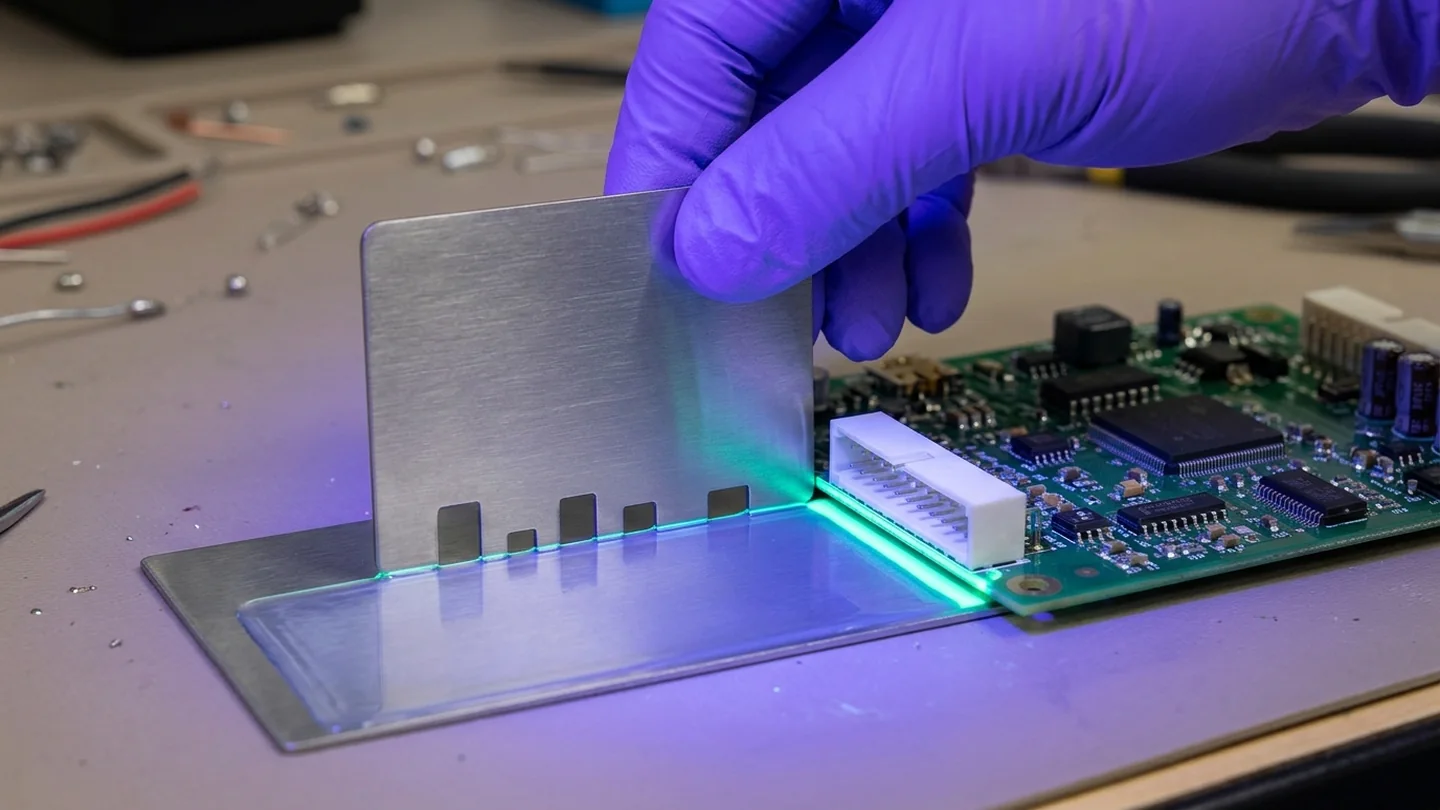
In selective conformal coating, overspray is unintended deposition outside the programmed target area during application, while creep is post-deposition wetting or flow into keep-outs. To troubleshoot selective conformal coating defects, HumiSeal recommends lowering atomization, reducing cone angle, increasing stand-off, and tightening overlaps for fogging or mist on shields and keep-outs, and jetting a perimeter first before filling with spray or film for creep at connectors. Lower solids and lower viscosity coatings will tend to flow off vertical surfaces more readily, whereas high solids and viscosities can have better adhesion to angled areas.
| Process Condition or Defect | Documented Mechanism or Scope | Documented Corrective Action or Configuration |
|---|---|---|
| Overspray vs. Creep | Overspray is unintended deposition outside the programmed target area during application | Creep is post-deposition wetting or flow into keep-outs |
| Fogging and Connector Creep | Fogging or mist on shields and keep-outs: lower atomization, reduce cone angle, increase stand-off, and tighten overlaps | Creep at connectors: jet a perimeter first, then fill with spray or film |
| Cobwebbing of Solvent-Based Fluids | The Nordson ASYMTEK SC-350 Select Spray applicator atomizes high-viscosity coating materials | Minimizes cobwebbing of solvent-based fluids; improves edge definition; allows selectivity and control near keep-out zones |
| Vertical Surface Flow-Off | Lower solids and lower viscosity coatings will tend to flow off vertical surfaces more readily | High solids and viscosities can have better adhesion to angled areas |
| Film Coater Viscosity Stability | The Select Coat SC-280 Film Coater is available in a non-circulating configuration | Circulating configuration with closed-loop temperature management for viscosity stability |
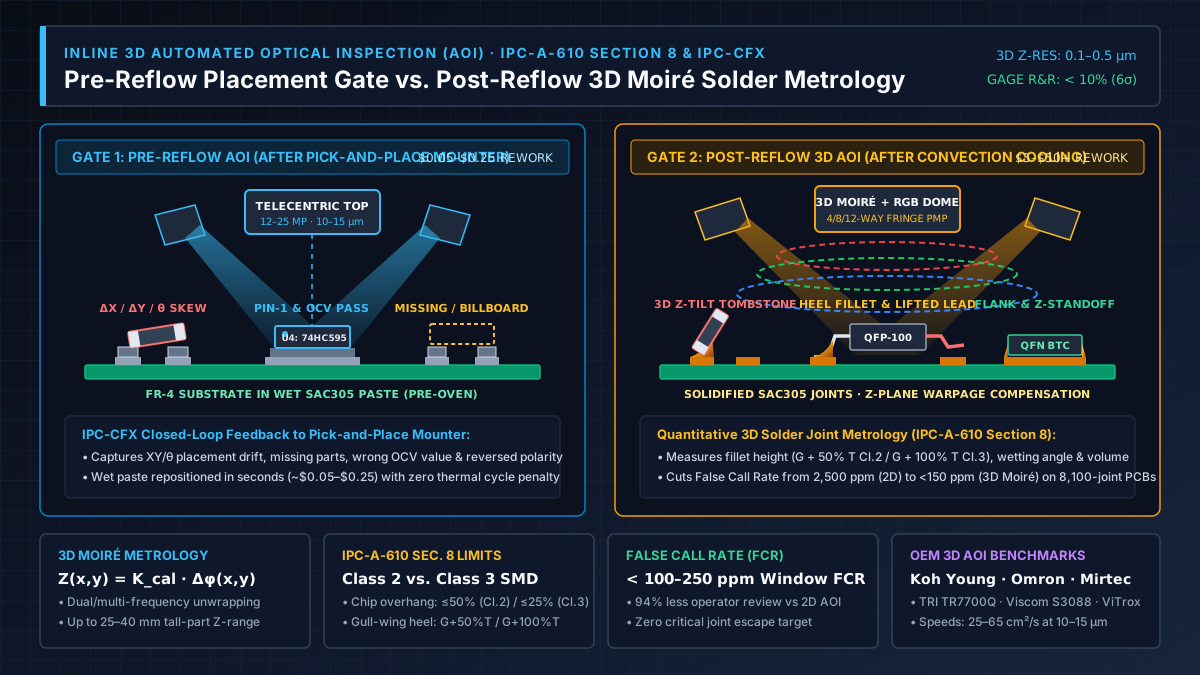
Upstream of the coating cell, solder joint and component placement quality can be verified with automated optical inspection (AOI) in SMT assembly before boards enter the conformal coating line.
Selective Conformal Coating Machine Specification Checklist
Review and record the following parameters before running equipment trials and line qualification:
- Target dry and wet film build: Calculate target wet film thickness from desired dry film thickness and solids by volume before measuring wet film build with notch gauges.
- Applicator mode and edge definition: Match valve selection to board geometry using spray for broader coverage, film coat for more uniform stripes, and jet or needle dispense for tight features and sharper boundaries.
- Carriage and valve configuration: Evaluate single-valve, dual-valve simultaneous, or triple-valve configurations according to board layout and throughput targets.
- Conveyor and board clearance: Confirm board width adjustment, top and bottom clearance above and below the PCB, and maximum pallet or PCB weight capacity.
Sources
- IPC — IPC-HDBK-830A Guidelines for Design, Selection and Application of Conformal Coatings
- Nordson ASYMTEK — Select Coat SL-940 Series Conformal Coating System Datasheet
- Nordson ASYMTEK — Select Coat SC-280 Film Coater Applicator Datasheet
- Nordson ASYMTEK — SC-300 Swirl Coat Applicator Datasheet
- Nordson ASYMTEK — Select Coat SC-350 Select Spray Applicator Datasheet
- PVA (Precision Valve & Automation) — FCS300-ES Stainless Steel Extended Spray Valve Datasheet
- PVA (Precision Valve & Automation) — ES Ultra Fine Extended Spray Valve Datasheet
- PVA (Precision Valve & Automation) — FC100-MC Stainless Steel Dispensing Valve Datasheet
- PVA / AB Electronic — FC100-CF Non-Atomized Film Coating Valve Specifications
- DeFelsko Corporation — How to Measure Wet Film Paint Thickness Before Cure
- HumiSeal / Chase Corporation — Selective Conformal Coating: Minimizing Overspray & Masking
- HumiSeal / Chase Corporation — How to Make Sure That Your Conformal Coating Actually Conforms
- HumiSeal — 1B31 Acrylic Conformal Coating Technical Data Sheet
- HumiSeal — 1C49 Silicone Conformal Coating Technical Data Sheet